Introduction
Small cell lung cancer (SCLC) can progress despite initial platinum-based chemotherapy, leaving patients with limited treatment options.
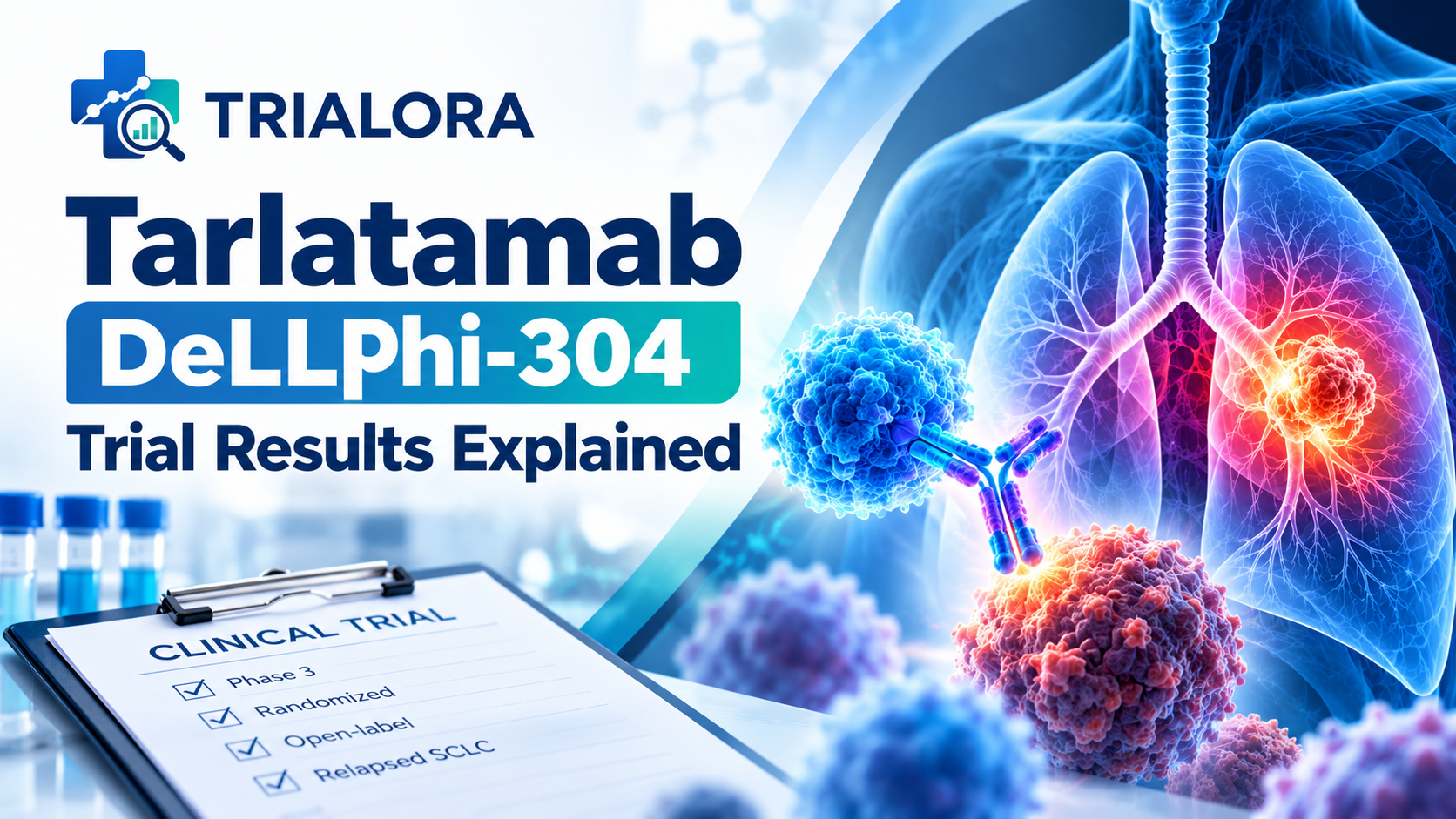
The DeLLphi-304 trial evaluated tarlatamab against standard-of-care chemotherapy in people with relapsed SCLC.
The trial was a randomized Phase 3 study designed to compare the two treatment approaches directly.
Trial Snapshot
| Field | Information |
| Trial | DeLLphi-304 |
| ClinicalTrials.gov ID | NCT05740566 |
| Sponsor | Amgen |
| Study phase | Phase 3 |
| Study type | Interventional |
| Trial status | Active, not recruiting |
| Primary endpoint | Overall survival |
Why This Study Matters
When SCLC returns or progresses after platinum-based chemotherapy, treatment becomes more difficult.
Researchers therefore continue to study treatments that may provide longer-lasting disease control.
Tarlatamab was developed as a different type of treatment from conventional chemotherapy. DeLLphi-304 tested it against standard chemotherapy in a randomized Phase 3 trial.
Understanding Small Cell Lung Cancer
SCLC is an aggressive form of lung cancer characterized by rapid growth and spread. Treatment commonly involves systemic therapies because the disease may affect multiple parts of the body.
The DeLLphi-304 study focused on people whose SCLC had progressed during or after first-line platinum-based chemotherapy, with or without an anti-PD-(L)-1 treatment.
At this stage of treatment, the study evaluated outcomes with tarlatamab compared with standard chemotherapy.
Understanding Tarlatamab
Tarlatamab is a bispecific T-cell engager. It is designed to bind to DLL3, a protein found on SCLC cells, and CD3, a protein on T cells. This brings T cells into close contact with cancer cells.
In DeLLphi-304, tarlatamab was given by intravenous infusion. Treatment began with a 1 mg dose on Cycle 1 Day 1, followed by 10 mg on Days 8 and 15 and then 10 mg every two weeks.
The chemotherapy comparison group received standard-of-care chemotherapy. The trial used lurbinectedin, topotecan, or amrubicin in Japan.
How the DeLLphi-304 Trial Was Conducted
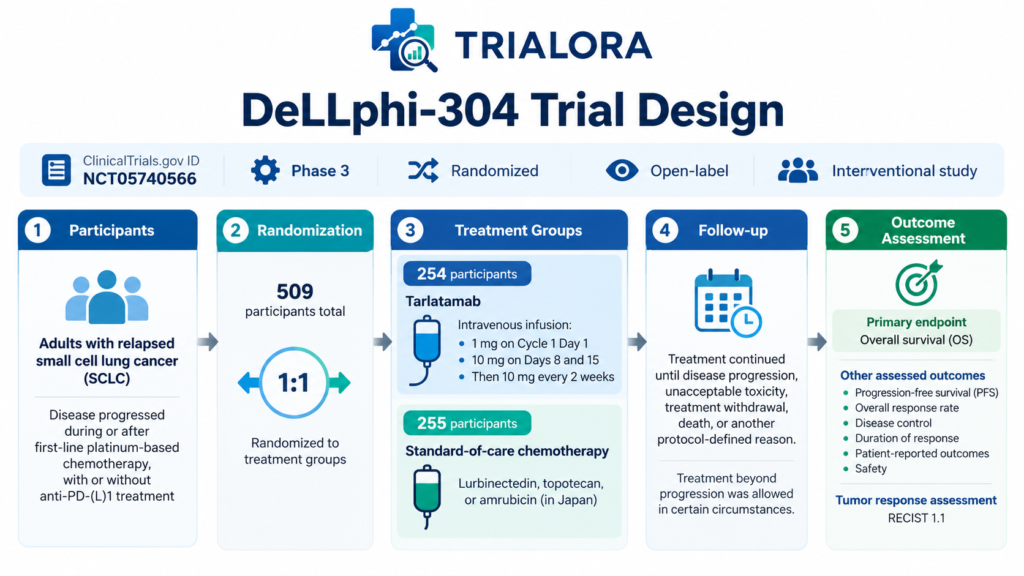
DeLLphi-304 was a randomized, open-label Phase 3 trial. Randomization means participants were assigned to treatment groups using a predefined process rather than allowing investigators or participants to choose the treatment.
The study compared tarlatamab with standard-of-care chemotherapy in a 1:1 allocation.
Treatment continued until disease progression, unacceptable toxicity, treatment withdrawal, death, or another protocol-defined reason. Treatment beyond progression was allowed in certain circumstances.
Who Participated?
The trial enrolled 509 adults with relapsed SCLC.
A total of 254 participants were assigned to tarlatamab and 255 to standard-of-care chemotherapy.
Participants generally had an ECOG performance status of 0 or 1, meaning they were able to carry out normal activities or were restricted in physically strenuous activity but remained ambulatory.
People with asymptomatic, stable brain metastases could participate.
What Did Researchers Want to Find Out?
The primary endpoint was overall survival (OS), which measures how long participants remained alive after entering the trial.
Researchers also assessed progression-free survival (PFS), which measures how long participants lived without their cancer worsening or dying.
Other measures included overall response rate, disease control, duration of response, patient-reported outcomes, and safety.
Tumor response was assessed using RECIST 1.1, a standardized system for measuring changes in cancer size on imaging.
What Were the DeLLphi-304 Trial Results?
Median overall survival was 13.6 months with tarlatamab compared with 8.3 months with standard-of-care chemotherapy.
The hazard ratio was 0.60 (95% CI, 0.47–0.77; P<0.001). A hazard ratio below 1 indicates a lower risk of death in the tarlatamab group in the reported analysis.
Progression-free survival also favored the tarlatamab group. The hazard ratio was 0.71 (95% CI, 0.59–0.86; P=0.002).
The reported statistical results showed differences between the treatment groups for both overall survival and progression-free survival.
Safety Findings
Safety was assessed among participants who received at least one dose of study treatment.
Serious adverse events occurred in 51.19% of participants receiving tarlatamab and 51.23% of those receiving standard-of-care chemotherapy.
Cytokine release syndrome (CRS), an immune reaction that can occur when immune cells become strongly activated, was reported in 45.63% of participants receiving tarlatamab.
Immune effector cell-associated neurotoxicity syndrome (ICANS), a neurological complication associated with some immune-based treatments, was also reported.
Study Strengths
A major strength was the randomized Phase 3 design, which provides a structured comparison between treatments.
The study also used an active chemotherapy comparator rather than comparing tarlatamab with no treatment or placebo.
Study Limitations
The trial was open-label, so participants and investigators knew which treatment was being given. This can influence some assessments, particularly outcomes that depend partly on subjective judgment.
The findings also apply most directly to people who met the trial’s eligibility criteria. Patients with different health characteristics or disease histories may not have the same outcomes.
The primary analysis used a data cutoff of January 29, 2025, while the overall study remained ongoing at that analysis.
What Do the Results Mean?
DeLLphi-304 provides randomized Phase 3 evidence for tarlatamab in the studied population.
Because the trial directly compared tarlatamab with standard-of-care chemotherapy, its findings can be interpreted within the conditions and eligibility criteria of that trial.
A separate matching-adjusted indirect comparison examined tarlatamab against paclitaxel and combination chemotherapy known as CAV. These treatments were not directly compared with tarlatamab in DeLLphi-304.
Because the analysis used data from separate clinical trials, its findings are subject to residual confounding and should be interpreted with caution.
What This Means for Patients
The DeLLphi-304 results provide evidence about how tarlatamab performed in a defined group of people with relapsed SCLC.
Clinical trial results describe outcomes across groups of participants. They cannot determine exactly how an individual patient will respond or which treatment is appropriate for that person.
Further research is needed to answer questions that are not fully addressed by the reported analysis.
What’s Next?
ClinicalTrials.gov lists the DeLLphi-304 study as active but not recruiting. Its estimated study completion date is March 26, 2028.
Continued follow-up can provide additional information about longer-term outcomes.
References
- ClinicalTrials.gov. Study Comparing Tarlatamab With Standard of Care Chemotherapy in Relapsed Small Cell Lung Cancer (DeLLphi-304). ClinicalTrials.gov Identifier: NCT05740566.
- Kurata T, Sugawara S, Akamatsu H, et al. Tarlatamab in small cell lung cancer following platinum-based chemotherapy: subgroup analysis of Japanese patients from the DeLLphi-304 study. International Journal of Clinical Oncology. 2026. doi:10.1007/s10147-026-03192-y.
- Dirnberger F, Patel S, Boyne DJ, et al. Matching-Adjusted Indirect Comparison of Tarlatamab for Patients with Platinum-Refractory or Platinum-Resistant Extensive-Stage Small-Cell Lung Cancer. Advances in Therapy. 2026;43:4282–4298. doi:10.1007/s12325-026-03659-4.
About This Article
This article explains the design, results, and findings of an individual clinical trial. It is based primarily on publicly available information from ClinicalTrials.gov and, where available, other supporting scientific or official sources referenced in the article.
Trialora independently prepares this content to help readers understand clinical trial information in clear and plain language. Trialora is not affiliated with, funded by, sponsored by, or endorsed by the study sponsor, investigators, ClinicalTrials.gov, or any regulatory authority, unless explicitly stated otherwise.
The information in this article reflects the study details and results available from the sources reviewed at the time of publication. Findings from one clinical trial should not automatically be considered applicable to every patient or population.
Trialora Promise
Every Trialora article is based primarily on publicly available evidence from ClinicalTrials.gov and other trusted scientific sources. Our mission is to explain complex clinical research in plain language while maintaining scientific accuracy, transparency, and objectivity.
Making Clinical Trials Easy to Understand.
Evidence-Based | Plain Language | Trusted Information
Medical Disclaimer
This article is intended for educational and informational purposes only. It summarizes findings from clinical research and should not be considered medical advice. Clinical trial results do not necessarily apply to every individual. Always consult a qualified healthcare professional before making decisions about your health or treatment.