Trialora | Oncology | Clinical Trial Results Explained
Introduction
Non-small cell lung cancer (NSCLC) is the most common type of lung cancer. When it spreads beyond the lungs, it is known as metastatic NSCLC. Treating advanced lung cancer can be challenging, particularly when the disease progresses after previous treatment.
Researchers are investigating whether cancer vaccines combined with immunotherapy could offer another approach to treating advanced lung cancer.
The Phase 1/2 clinical trial NCT03164772 evaluated an investigational mRNA-based cancer vaccine, BI 1361849, alongside immune checkpoint inhibitors in people with metastatic NSCLC. The study is completed, and its results are available.
Why Was This Study Conducted?
BI 1361849 was developed to target several proteins associated with cancer cells. The study evaluated the safety and preliminary antitumor activity of combining this vaccine with immune checkpoint inhibitors.
Two treatment combinations were investigated: one combining the vaccine with durvalumab and another adding tremelimumab.
What Treatments Were Investigated?
The study evaluated the following treatments:
- BI 1361849 (CV9202): An investigational mRNA-based cancer vaccine containing six components encoding MUC1, survivin, NY-ESO-1, 5T4, MAGE-C2 and MAGE-C1.
- Durvalumab: An immune checkpoint inhibitor that targets programmed death-ligand 1 (PD-L1).
- Tremelimumab: An immune checkpoint inhibitor that targets cytotoxic T-lymphocyte-associated protein 4 (CTLA-4).
How Was the Trial Designed?
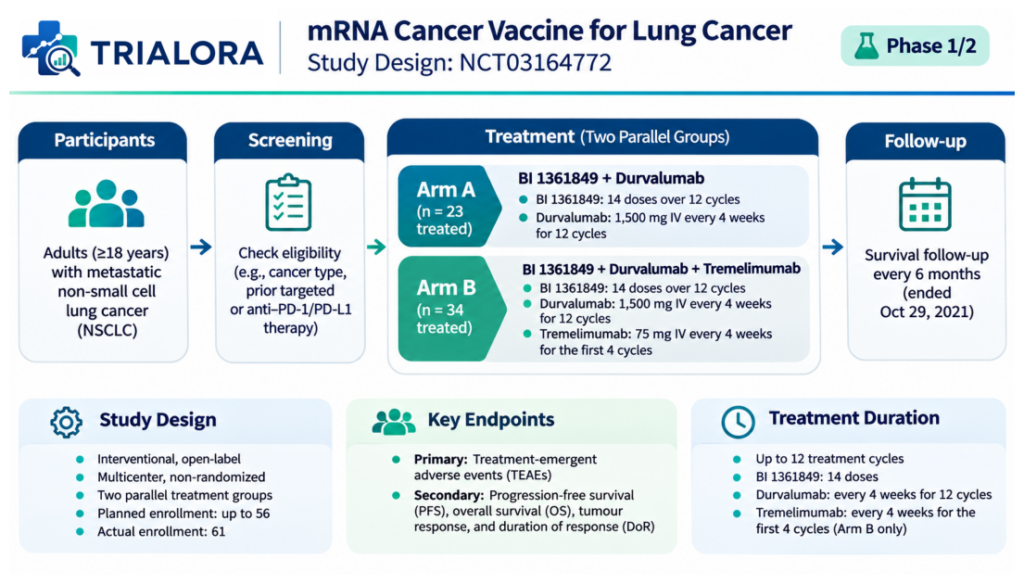
NCT03164772 was an interventional, open-label, multicenter, non-randomized Phase 1/2 study with two parallel treatment groups.
| Treatment group | Study treatment |
| Arm A | BI 1361849 + durvalumab |
| Arm B | BI 1361849 + durvalumab + tremelimumab |
The study planned to enroll up to 56 participants. Actual enrolment was 61.
Who Participated?
The study included adults aged 18 years or older with histologically confirmed metastatic NSCLC.
Participants with known EGFR or ALK/ROS-1 mutations were required to have received the relevant targeted treatment. Participants could also have received one previous line of anti-PD-1 or anti-PD-L1 therapy, subject to the study’s eligibility requirements.
A total of 57 participants received at least one dose of study treatment.
| Participant details | Arm A | Arm B |
| Received at least one dose | 23 | 34 |
| Mean age (years) | 64.9 | 64.5 |
How Were the Treatments Administered?
The six vaccine components were administered separately into the skin using the PharmaJet Tropis device. Each component was administered twice, resulting in 12 intradermal administrations of 100 μL (80 μg) each for each dose.
| Treatment | Dose and schedule |
| BI 1361849 | 14 doses over 12 treatment cycles |
| Durvalumab | 1,500 mg intravenously every 4 weeks for 12 cycles |
| Tremelimumab | 75 mg intravenously every 4 weeks for the first 4 cycles in Arm B only |
What Did Researchers Measure?
The primary endpoint was the number of participants experiencing treatment-emergent adverse events (TEAEs). These are medical problems that developed or worsened after treatment began.
Secondary endpoints included:
- Progression-Free Survival (PFS): Time from the first treatment dose until disease progression or death.
- Overall Survival (OS): Time from the first treatment dose until death or the last follow-up.
- Tumour response: Whether tumours showed a complete or partial response.
- Duration of Response (DoR): Time from the first documented complete or partial response until disease progression, clinical progression or death.
Tumour response was assessed using RECIST 1.1 and immune-related RECIST (irRECIST), standardized methods for measuring changes in tumours during clinical trials.
What Were the Results?
Tumour response
The best overall tumour response analysis included participants who received at least one dose of treatment and had both baseline and at least one post-baseline tumour assessment.
The response categories were:
- Complete response (CR): Disappearance of all target lesions.
- Partial response (PR): At least a 30% decrease in the sum of the longest diameters of target lesions.
- Stable disease (SD): Changes that do not meet the criteria for partial response or progressive disease.
- Progressive disease (PD): An increase in tumour size or the appearance of new lesions, according to the applicable response criteria.
Under irRECIST, progressive disease (irPD) was defined as an increase of at least 20% from the lowest recorded total measurable tumour burden (TMTB).
| Best overall response | Arm A (n=19) | Arm B (n=27) |
| Complete response | 0 | 0 |
| Partial response | 5 | 3 |
| Stable disease | 7 | 8 |
| Progressive disease | 7 | 16 |
The same response counts were reported under irRECIST.
Progression-free survival
Median PFS was estimated using the Kaplan-Meier method, a statistical approach for estimating the time until an event such as disease progression or death.
| PFS measurement | Arm A | Arm B |
| Median PFS by RECIST 1.1 | 2.0 months | 1.8 months |
| 95% confidence interval | 1.8–7.3 months | 1.2–2.8 months |
| Median PFS by irRECIST | 2.0 months | 1.8 months |
| 95% confidence interval | 1.8–13.6 months | 1.2–2.8 months |
The study also reported the number of participants without disease progression at Weeks 8 and 24.
| Assessment | Arm A | Arm B |
| Week 8 (RECIST 1.1) | 11 | 11 |
| Week 24 (RECIST 1.1) | 8 | 3 |
| Week 8 (irRECIST) | 11 | 11 |
| Week 24 (irRECIST) | 10 | 3 |
Duration of response
DoR measures how long a documented complete or partial response lasts before disease progression, clinical progression or death.
| Measurement | Arm A | Arm B |
| Median DoR | 43.1 weeks | 25.1 weeks |
| 95% confidence interval | 24.1–53.5 weeks | 23.2–27.5 weeks |
Overall survival
Overall survival measures the time from the first treatment dose until death or the last follow-up.
| Measurement | Arm A | Arm B |
| Median OS | 23.5 months | 7.5 months |
| 95% confidence interval | 3.5 months–NA | 3.4–10.5 months |
The upper confidence limit for Arm A was recorded as NA, meaning it was not estimable. Survival follow-up was conducted every six months and ended on October 29, 2021.
What Were the Safety Findings?
Safety was assessed among participants who received at least one dose of treatment.
| Safety measure | Arm A (n=23) | Arm B (n=34) |
| Participants with TEAEs | 23 | 33 |
| Participants with treatment-related AEs | 13 | 19 |
| Participants with serious TEAEs | 14 | 22 |
| Participants with treatment-related serious AEs | 1 | 3 |
| TEAEs leading to treatment discontinuation | 5 | 8 |
| Deaths within the AE reporting period | 5 | 7 |
The AE reporting period included deaths during study treatment or up to 90 days after the last dose of study treatment or initiation of a new treatment. These counts should not be interpreted as deaths caused by study treatment.
Other reported adverse events included:
| Adverse event | Arm A | Arm B |
| Fatigue | 8 | 11 |
| Nausea | 5 | 11 |
| Vomiting | 6 | 8 |
| Diarrhoea | 6 | 6 |
| Decreased appetite | 8 | 9 |
| Chills | 7 | 3 |
| Anaemia | 7 | 3 |
Pneumonia was recorded as a serious adverse event in 4 participants in each arm.
Separately, the participant-flow results listed death as a reason for not completing all 12 treatment cycles in 4 participants in Arm A and 2 in Arm B. These participant-flow counts are distinct from the deaths recorded within the AE reporting period.
What Are the Study’s Limitations?
Several limitations affect how the findings should be interpreted:
- Small participant population: Although 61 participants were enrolled, 57 received treatment. This limits the information available about treatment outcomes and safety.
- Non-randomized design: Participants were not randomly assigned to treatment groups. The study design does not establish whether one treatment combination was more effective or safer than the other.
- Limited survival follow-up: Post-study survival follow-up ended on October 29, 2021. The study did not report longer-term survival information beyond this date.
- Preliminary efficacy assessment: The study was designed to evaluate safety and preliminary efficacy, rather than establish definitive treatment effectiveness.
What Do the Findings Mean?
Partial tumour responses were observed in both treatment groups, while disease progression was also reported. The results provide preliminary information about the combinations studied, but they do not establish definitive clinical benefit.
Because the study was non-randomized and involved a small number of participants, the results cannot establish whether adding tremelimumab provides an additional benefit.
What Happens Next?
The study is completed, and its results are available.
The study did not report this information regarding a subsequent confirmatory trial or further development plan for these specific treatment combinations.
References
- ClinicalTrials.gov. A Phase 1/2 Study of Combination Immunotherapy and mRNA Vaccine in Subjects With Non-small Cell Lung Cancer (NSCLC). ClinicalTrials.gov Identifier: NCT03164772. https://clinicaltrials.gov/study/NCT03164772
- Eisenhauer EA, Therasse P, Bogaerts J, et al. New response evaluation criteria in solid tumours: Revised RECIST guideline (version 1.1). European Journal of Cancer. 2009;45:228–247. doi:10.1016/j.ejca.2008.10.026.
- Bohnsack O, Ludajic K, Hoos A. Adaptation of the immune-related response criteria: irRECIST. ESMO 2014 Abstract 4958.
About This Article
This article explains the design, results and findings of the NCT03164772 clinical trial. It is based primarily on publicly available clinical trial information and supporting scientific documents.
Trialora independently prepares this content to help readers understand clinical trial information in clear and plain language. Trialora is not affiliated with, funded by, sponsored by, or endorsed by the study sponsor, investigators, ClinicalTrials.gov, or any regulatory authority, unless explicitly stated otherwise.
The information in this article reflects the study details and results available from the sources reviewed at the time of publication. Findings from one clinical trial should not automatically be considered applicable to every patient or population.
Trialora Promise
Every Trialora article is based primarily on publicly available evidence from ClinicalTrials.gov and other trusted scientific sources. Our mission is to explain complex clinical research in plain language while maintaining scientific accuracy, transparency and objectivity.
Making Clinical Trials Easy to Understand.
Evidence-Based | Plain Language | Trusted Information
Medical Disclaimer
Medical Disclaimer: This content is intended for educational purposes only and should not be considered medical advice. Always consult a qualified healthcare professional regarding medical decisions.