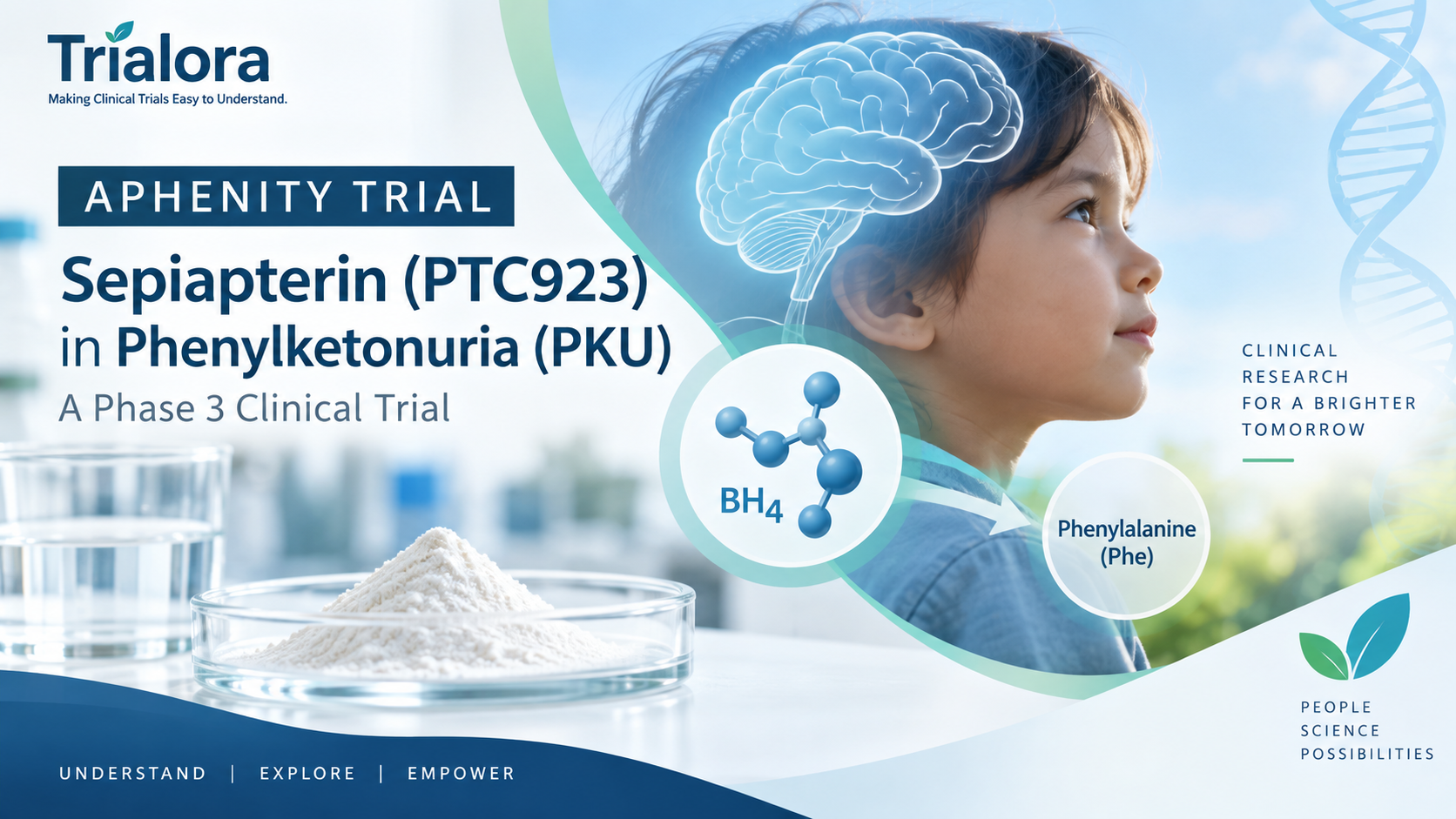
A closer look at how the Phase 3 APHENITY trial tested sepiapterin, what researchers found, and what the results mean
For people living with phenylketonuria (PKU), controlling blood phenylalanine levels is an important part of managing the condition.
The APHENITY trial asked whether sepiapterin could help lower blood phenylalanine levels in people with PKU.
The study evaluated PTC923, called sepiapterin in the published reports. It used two stages. First, participants received sepiapterin for 14 days. Participants who met the response criteria could then enter a six-week randomized comparison of sepiapterin and placebo.
The randomized results showed a substantially greater reduction in blood phenylalanine levels with sepiapterin than with placebo.
However, the way participants moved through the two stages is important when interpreting the results.
APHENITY Trial at a Glance
| Study feature | Details |
| Trial | APHENITY |
| ClinicalTrials.gov ID | NCT05099640 |
| Condition | Phenylketonuria (PKU) |
| Study drug | PTC923, called sepiapterin in publications |
| Comparator | Placebo |
| Phase | Phase 3 |
| Participants enrolled | 157 |
| Part 1 | 14-day open-label treatment |
| Part 2 | Six-week randomized, placebo-controlled treatment |
| Masking | Quadruple-masked |
| Sponsor | PTC Therapeutics |
ClinicalTrials.gov reports that the study was completed in 2023 and that results were first posted in January 2024.
Why Was the APHENITY Trial Conducted?
To understand the reason for the study, it helps to start with PKU.
Phenylketonuria (PKU) is a genetic condition that can cause phenylalanine to build up in the body.
Phenylalanine is an amino acid, a building block used to make proteins.
Normally, an enzyme called phenylalanine hydroxylase (PAH) helps convert phenylalanine into tyrosine.
In PKU, changes affecting PAH can reduce the body’s ability to process phenylalanine. This can lead to high blood phenylalanine levels.
High phenylalanine levels can affect brain development, thinking, behavior, and movement.
Because controlling phenylalanine is an important part of PKU management, APHENITY was designed to test whether sepiapterin could reduce blood phenylalanine levels.
How Does Sepiapterin Work?
The study drug was PTC923, called sepiapterin in the published reports.
The treatment works through the BH4 pathway.
BH4, or tetrahydrobiopterin, is a helper molecule involved in PAH activity. Sepiapterin is converted into BH4 inside cells, and BH4 can help PAH break down phenylalanine more efficiently.
The goal was to determine whether this biological effect could produce a measurable reduction in blood phenylalanine levels.
How Did the APHENITY Trial Work?
APHENITY was a Phase 3 trial with randomized, parallel-group assignment and quadruple masking during the randomized phase.
Randomization means participants are assigned to treatment groups by chance.
Quadruple masking means that participants, care providers, investigators, and outcome assessors were masked to treatment assignment.
But the trial did not begin with randomization.
Instead, researchers first used a 14-day treatment period to identify participants who responded to sepiapterin.
Part 1: The Responder Period
All 157 participants received sepiapterin for 14 days.
This was an open-label period, meaning participants and study staff knew that sepiapterin was being given.
For participants aged 2 years or older, a reduction of at least 15% in blood phenylalanine was used to define a responder who could continue into Part 2.
Participants younger than 2 years who responded could instead be offered entry into an open-label extension study.
Among the 156 participants whose response could be evaluated, 114 achieved at least a 15% reduction in blood phenylalanine.
That brought the trial to its second stage.
Part 2: The Randomized Comparison
A total of 110 participants were eligible to continue into Part 2.
They were assigned to:
- 56 participants receiving sepiapterin
- 54 participants receiving placebo
Before Part 2, participants had at least a 14-day washout period.
During the six-week treatment period, the sepiapterin dose increased every two weeks:
| Treatment period | Sepiapterin dose |
| Weeks 1–2 | 20 mg/kg daily |
| Weeks 3–4 | 40 mg/kg daily |
| Weeks 5–6 | 60 mg/kg daily |
The placebo group received matching quantities corresponding to the same dose-escalation schedule.
At this point, the study could directly compare changes in blood phenylalanine between the two groups.
Why Were 49 Participants in Each Group Included in the Primary Analysis?
Although 56 participants received sepiapterin and 54 received placebo, the primary efficacy analysis included 49 participants in each group.
The reason was another response requirement.
For the primary efficacy analysis, participants needed to have achieved at least a 30% reduction in blood phenylalanine during Part 1.
The two thresholds therefore had different purposes:
- 15% reduction: eligibility to continue into Part 2
- 30% reduction: inclusion in the primary efficacy analysis
This means the main efficacy results came from a selected analysis population rather than everyone who initially entered the trial.
Who Participated in the Trial?
The APHENITY trial enrolled 157 participants with PKU.
ClinicalTrials.gov required participants to have uncontrolled blood phenylalanine levels of at least 360 μmol/L during screening and a documented history of at least two blood phenylalanine measurements of at least 600 μmol/L.
The reported average age was 17.7 years, and the average blood phenylalanine level was 712.2 μmol/L.
Among the participants:
- 36 of 157 had classic PKU.
- 56 of 157 had previously not responded to sapropterin dihydrochloride.
Participants also had to stop certain other PKU medications before receiving study treatment, including sapropterin dihydrochloride and pegvaliase.
The sources report different site counts. The publication describes 34 sites in 13 countries, while the ClinicalTrials.gov record lists 43 locations. This article therefore does not present one figure as definitive.
What Was the Trial Designed to Measure?
The main question was whether sepiapterin could reduce blood phenylalanine more than placebo during the randomized treatment period.
The current ClinicalTrials.gov record lists two primary outcomes:
- Mean change from baseline in blood phenylalanine at Weeks 5 and 6.
- Percent change from baseline in blood phenylalanine at Weeks 5 and 6.
The study also examined whether participants reached specific blood phenylalanine thresholds, including below 600 μmol/L and below 360 μmol/L.
These measures allowed researchers to look at both the average change in blood phenylalanine and how many participants reached lower levels.
What Did the APHENITY Trial Find?
The difference between the treatment groups became clear during the randomized period.
Among participants included in the primary efficacy analysis, the mean baseline blood phenylalanine level was:
- 646.1 μmol/L in the sepiapterin group
- 654.0 μmol/L in the placebo group
By Weeks 5 and 6, the mean levels were:
| Blood phenylalanine result | Sepiapterin | Placebo |
| Mean baseline | 646.1 μmol/L | 654.0 μmol/L |
| Mean Week 5–6 level | 236.0 μmol/L | 637.9 μmol/L |
| Mean change | −410.1 μmol/L | −16.2 μmol/L |
The least-squares mean difference between groups was −395.9 μmol/L, with a standard error of 33.8 and P<0.0001.
The percent-change analysis showed the same overall pattern.
The least-squares mean percent change was:
- −63.40% with sepiapterin
- 0.82% with placebo
The between-group difference was −64.22 percentage points, with a 95% confidence interval of −74.09 to −54.35 and P<0.0001.
A confidence interval describes the uncertainty around an estimated treatment difference.
Taken together, these results showed a substantially greater reduction in blood phenylalanine with sepiapterin than with placebo during the six-week randomized treatment period.
Did More Participants Reach Lower Phenylalanine Levels?
Researchers also examined whether participants reached a blood phenylalanine level below 360 μmol/L during Weeks 5 and 6.
Among the participants included in this analysis:
- 37 of 44 participants receiving sepiapterin reached below 360 μmol/L.
- 4 of 44 participants receiving placebo reached below 360 μmol/L.
That corresponded to:
- 84% with sepiapterin
- 9% with placebo
The reported odds ratio was 30.33, with a 95% confidence interval of 5.30 to 294.24.
This was a secondary outcome.
What About Side Effects?
The trial also monitored safety during treatment.
During Part 2, 33 of 56 participants receiving sepiapterin had at least one adverse event. That represented 59% of the group.
Among participants receiving placebo, 18 of 54 had at least one adverse event, or 33%.
| Safety finding during Part 2 | Sepiapterin | Placebo |
| At least one adverse event | 33/56 (59%) | 18/54 (33%) |
| Serious adverse event | None reported | None reported |
| Treatment stopped because of an adverse event | None reported | None reported |
| Trial withdrawal because of an adverse event | None reported | None reported |
An adverse event is an unwanted medical occurrence during a clinical trial. It does not necessarily mean the treatment caused the event.
A serious adverse event is an event that meets specific seriousness criteria, such as being life-threatening, requiring hospitalization, or causing significant disability.
The reported adverse-event categories included gastrointestinal events such as diarrhea, vomiting, and nausea, along with infections and other events.
The safety findings therefore showed adverse events in both groups, with a higher reported frequency in the sepiapterin group during Part 2.
What Were the Strengths of the Trial?
APHENITY had several features that helped researchers compare the two treatment groups.
The randomized portion included a placebo-controlled comparison, allowing researchers to assess changes in blood phenylalanine against a control group.
The randomized phase was also quadruple-masked, reducing the potential influence of knowing the treatment assignment.
The study included children and adults and included participants with classic PKU and previous nonresponse to sapropterin.
What Were the Limitations?
The randomized placebo-controlled period lasted only six weeks.
This provides information about blood phenylalanine changes during that period, but it does not establish how the treatment effect or safety findings would look over much longer periods.
The two-stage design is another important consideration.
Participants first had to demonstrate a response during Part 1 before continuing into Part 2. The primary efficacy analysis then focused on participants who had achieved at least a 30% reduction in blood phenylalanine during Part 1.
The primary efficacy findings should therefore be understood in the context of this selected analysis population.
What Do the APHENITY Results Mean?
The main finding from APHENITY is that, during the six-week randomized treatment period, participants included in the primary analysis had a substantially greater reduction in blood phenylalanine with sepiapterin than with placebo.
But the context of that finding matters.
The primary efficacy analysis did not include everyone who initially entered the study. It focused on participants who had already demonstrated at least a 30% reduction in blood phenylalanine during Part 1.
The results therefore describe the treatment effect observed in that analyzed population under the conditions of the trial.
They do not establish that every person with PKU would experience the same reduction.
The six-week randomized treatment period also limits what the study can tell us about longer-term efficacy and safety.
What Happens Next?
The questions raised by APHENITY extend beyond the six-week randomized period.
Longer studies are needed to understand the long-term efficacy and safety of sepiapterin.
The study program also includes research examining whether sepiapterin could allow people with PKU to eat a wider variety of foods containing more natural protein.
ClinicalTrials.gov identifies an open-label extension study, PTC923-MD-004-PKU (NCT05166161), that eligible participants could enter after the APHENITY treatment period.
These studies address questions that the six-week randomized period could not fully answer.
Frequently Asked Questions
What was the APHENITY trial?
APHENITY was a Phase 3 clinical trial studying PTC923, called sepiapterin in published reports, in people with PKU.
How was the trial designed?
Participants first received sepiapterin for 14 days. Eligible responders then entered a six-week randomized comparison of sepiapterin and placebo.
Why were two response thresholds used?
A 15% reduction in blood phenylalanine was used to determine eligibility to continue into Part 2. The primary efficacy analysis then focused on participants who had achieved at least a 30% reduction during Part 1.
Did sepiapterin lower blood phenylalanine?
Yes. During the randomized period, blood phenylalanine levels decreased substantially more with sepiapterin than with placebo in the primary analysis population.
How many participants were included in the primary efficacy analysis?
The primary efficacy analysis included 49 participants in the sepiapterin group and 49 in the placebo group.
What safety findings were reported?
Adverse events occurred in both treatment groups. No serious adverse events or treatment discontinuations because of adverse events were reported during Part 2.
Does APHENITY establish long-term effects?
No. The randomized placebo-controlled period lasted six weeks. Longer studies are needed to understand long-term efficacy and safety.
Does the trial show that sepiapterin will work for everyone with PKU?
No. The randomized analysis focused on participants who had already demonstrated a response during Part 1, and the controlled treatment period lasted six weeks. The findings should not be interpreted as an individual treatment outcome.
Key Takeaways
- APHENITY was a Phase 3 trial of PTC923, called sepiapterin in published reports.
- The trial enrolled 157 participants and used a two-stage responder-based design.
- 110 participants entered the randomized Part 2 comparison.
- The primary efficacy analysis included 49 participants in each treatment group.
- Blood phenylalanine levels decreased substantially more with sepiapterin than with placebo during the six-week randomized period.
- More participants in the relevant analysis reached blood phenylalanine below 360 μmol/L with sepiapterin than with placebo.
- Adverse events occurred in both treatment groups.
- The six-week randomized period and responder-based design are important when interpreting the findings.
- Longer-term studies are needed to understand how the efficacy and safety findings develop over time.
References
- ClinicalTrials.gov. A Study of PTC923 in Participants With Phenylketonuria. ClinicalTrials.gov Identifier: NCT05099640. Sponsor: PTC Therapeutics.
- Muntau AC, Longo N, Ezgu F, et al. Effects of oral sepiapterin on blood Phe concentration in a broad range of patients with phenylketonuria (APHENITY): results of an international, phase 3, randomised, double-blind, placebo-controlled trial. The Lancet. 2024;404(10460):1333–1345.
- Muntau AC, Gallagher S, Lah M, Belanger-Quintana A, Longo N. Sepiapterin as a treatment for people living with phenylketonuria: a plain language summary of the APHENITY trial. Journal of Comparative Effectiveness Research. 2026;15(1):e250116.
About This Article
This article explains the design, results, and findings of the APHENITY clinical trial. It is based primarily on publicly available clinical trial information and supporting scientific publications.
Trialora independently prepares this content to help readers understand clinical trial information in clear and plain language. Trialora is not affiliated with, funded by, sponsored by, or endorsed by the study sponsor, investigators, ClinicalTrials.gov, or any regulatory authority, unless explicitly stated otherwise.
The information in this article reflects the study details and results available from the sources reviewed at the time of publication. Findings from one clinical trial should not automatically be considered applicable to every patient or population.
Trialora Promise
Every Trialora article is based primarily on publicly available evidence from ClinicalTrials.gov and other trusted scientific sources. Our mission is to explain complex clinical research in plain language while maintaining scientific accuracy, transparency, and objectivity.
Making Clinical Trials Easy to Understand.
Evidence-Based | Plain Language | Trusted Information
Medical Disclaimer
Medical Disclaimer: This article is intended for educational and informational purposes only. It summarizes findings from clinical research and should not be considered medical advice. Clinical trial results do not necessarily apply to every individual. Always consult a qualified healthcare professional before making decisions about your health or treatment.