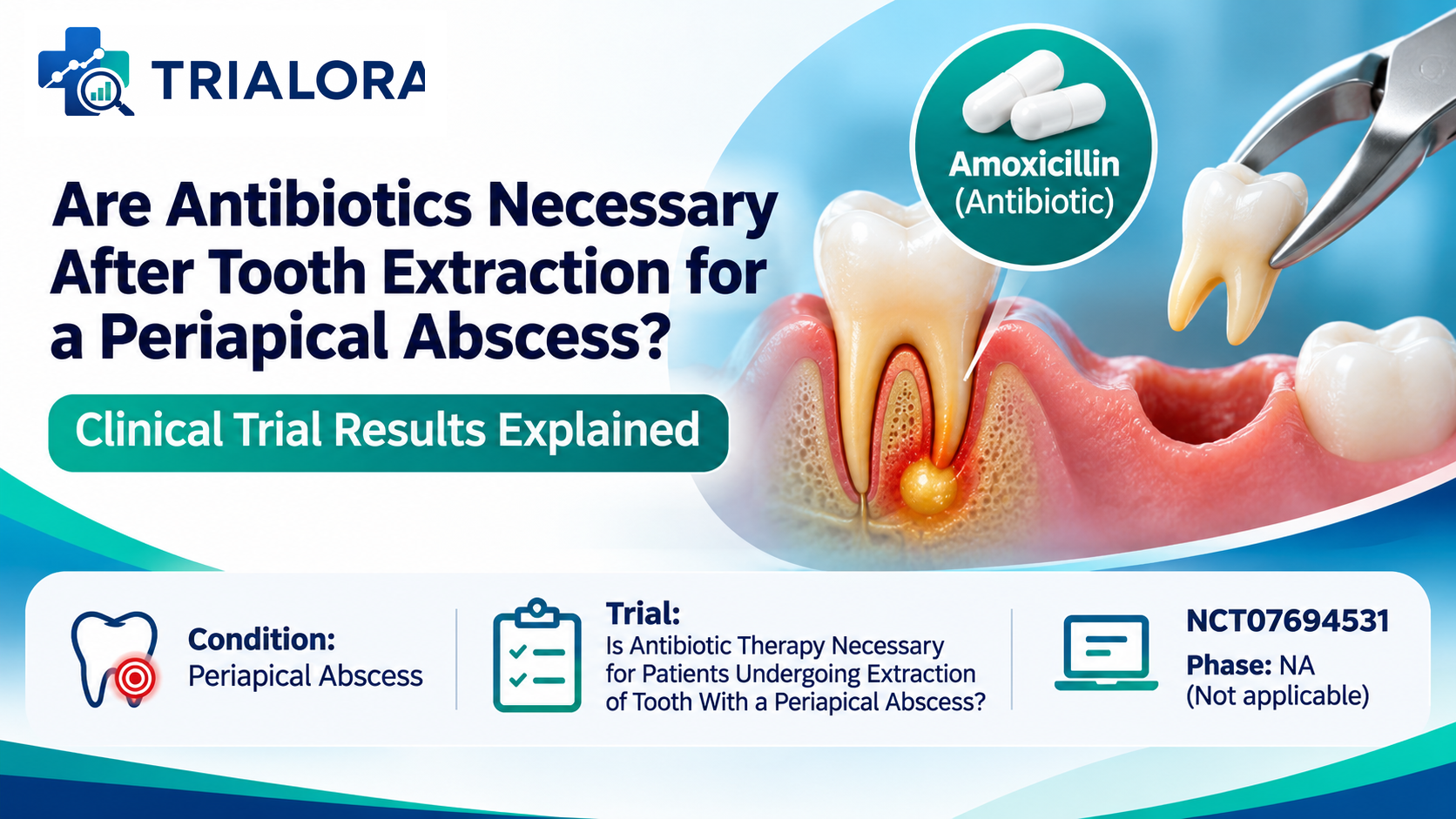
Why is antibiotic use after tooth extraction an important question?
When a tooth is severely damaged by decay and cannot be restored, extraction may be necessary. In patients with a periapical abscess, an important research question is whether antibiotics are needed after the procedure to support wound healing.
Does adding an antibiotic after tooth extraction improve recovery compared with providing pain-relief medication alone?
A clinical trial conducted in India investigated this question by comparing two postoperative treatment approaches.
What treatments were compared?
The study investigated amoxicillin, an antibiotic belonging to the penicillin group.
Participants received one of two postoperative approaches:
- Amoxicillin group: Amoxicillin 500 mg three times daily after food for five days, along with standard analgesics.
- No-antibiotic group: Standard analgesics without a postoperative antibiotic prescription.
Both groups underwent intra-alveolar tooth extraction. The study intervention record describes the procedure as being performed under local anaesthesia.
How was the clinical trial conducted?
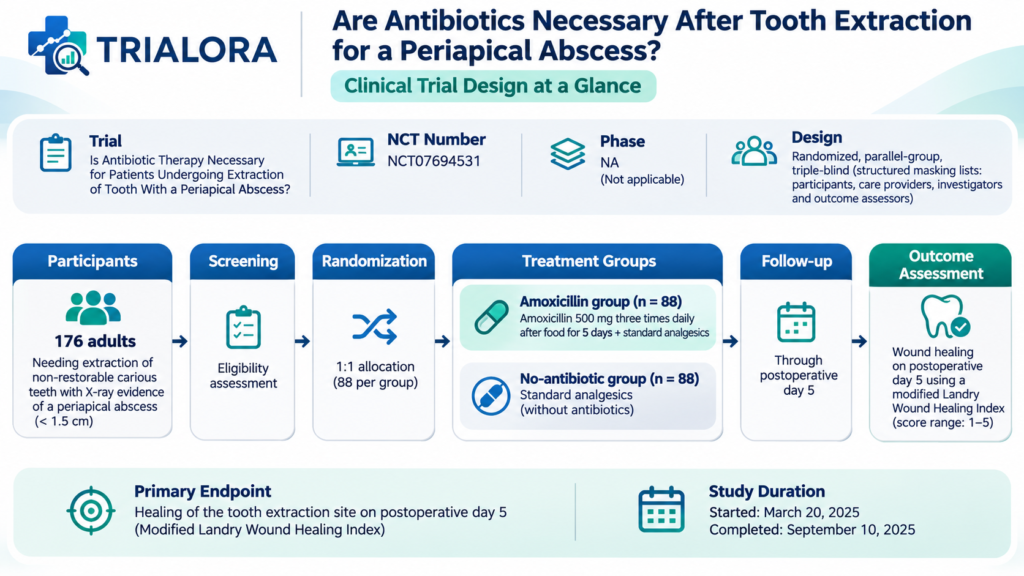
This was a randomized, parallel-group interventional clinical trial conducted at the Department of Oral and Maxillofacial Surgery, Subbaiah Institute of Dental Sciences, Shimoga, Karnataka, India.
The trial was registered as an interventional study, with its clinical trial phase listed as NA (not applicable). Its overall status is completed.
A total of 176 participants were randomly assigned to the two treatment groups, with 88 participants in each group.
The study description identifies the design as triple-blind. However, the structured design information identifies four masked groups: participants, care providers, investigators and outcome assessors. This difference in the reported masking arrangements remains unresolved in the trial record.
The study started on March 20, 2025. Its primary completion date was September 5, 2025, and its overall completion date was September 10, 2025.
Who participated in the study?
The trial enrolled 176 adults requiring extraction of non-restorable carious teeth with X-ray evidence of a periapical abscess measuring less than 1.5 cm.
Participants had to meet American Society of Anesthesiologists (ASA) physical status classes I or II, which generally describe people who are healthy or have mild systemic disease.
The eligibility criteria specified patients older than 18 years, while the minimum-age field listed 18 years. The baseline characteristics categorized participants within the 18–65-year age range. These differences are retained as reported in the trial record.
Patients with a known penicillin allergy, pregnant women, and those requiring surgical tooth extraction were excluded. Patients receiving antibiotics around the time of surgery or unable to comply with follow-up were also excluded.
Participant-flow data recorded all 176 enrolled participants as having completed the study, with none recorded as not completed. Separate treatment-discontinuation counts were not reported.
How was wound healing measured?
The primary outcome was healing of the tooth extraction site on postoperative day 5.
Researchers used a modified Landry’s Wound Healing Index, which assesses four features:
- Gum tissue colour: Whether the healing tissue appeared more than 50% red or completely pink.
- Response to palpation: Whether bleeding occurred when the area was examined.
- Granulation tissue: Whether new tissue involved in wound healing was present.
- Suppuration: Whether pus was present at the extraction site.
The assessment used a score ranging from 1 (Very Poor) to 5 (Excellent).
What were the clinical trial results?
The registered mean wound-healing scores on postoperative day 5 were:
| Treatment group | Participants | Mean score | Reported standard deviation |
| Amoxicillin | 88 | 3.97 | 2.131 |
| No antibiotics | 88 | 3.65 | 2.062 |
The mean score was numerically higher in the amoxicillin group than in the no-antibiotic group.
However, the study record did not report a p-value, confidence interval or statistical comparison to establish whether the difference was statistically significant.
Data note: The mean scores and standard deviations are reproduced as reported in the ClinicalTrials.gov study results. The source does not provide further clarification of the reported standard deviations.
Consequently, the available results cannot establish whether postoperative amoxicillin meaningfully improved wound healing.
What safety findings were reported?
The study reported cases of dry socket, a condition that can develop after tooth extraction when the underlying bone becomes exposed, often causing localized pain.
| Safety finding | Amoxicillin group | No-antibiotic group |
| Dry socket | 1/88 (1.14%) | 3/88 (3.41%) |
| Serious adverse events | 0/88 | 0/88 |
| Deaths | 0/88 | 0/88 |
The safety assessment covered the follow-up period through postoperative day 5. The trial record describes dry socket as being diagnosed clinically by the presence of exposed bone or an empty socket with localized pain on postoperative days 3–5.
What are the study limitations?
The study record states that no limitations interfered with the outcomes of the intervention.
However, several limitations should be considered when interpreting the publicly reported results:
- Wound healing was assessed only on postoperative day 5.
- The study was conducted at a single dental institution.
- Statistical comparisons between treatment groups were not reported.
- The source does not provide further clarification of the reported standard deviations.
- Longer-term wound-healing outcomes were not reported.
These points relate to the available study design and reporting; they do not establish that the investigators identified these issues as study limitations.
What do the findings mean?
This trial examined whether postoperative amoxicillin provides an additional wound-healing benefit following tooth extraction for a periapical abscess.
The mean wound-healing score was numerically higher in the amoxicillin group. However, the absence of a reported statistical comparison means that the significance of this difference cannot be determined from the available results.
The available trial results therefore do not establish whether postoperative antibiotics provide an additional wound-healing benefit or whether either treatment approach is superior.
The findings should not be interpreted as evidence that antibiotics are unnecessary for every patient with a dental abscess. Treatment decisions should be made by a qualified dental professional based on the individual patient’s clinical condition.
What happens next?
The study has been completed.
The study record did not report whether additional follow-up studies or subsequent research are planned.
Reference
- ClinicalTrials.gov. Is Antibiotic Therapy Necessary for Patients Undergoing Extraction of Tooth With a Periapical Abscess? A Randomised Controlled Clinical Study. NCT07694531.
https://clinicaltrials.gov/study/NCT07694531
About This Article
This article explains the design, results, and findings of a clinical trial. It is based primarily on publicly available clinical trial information.
Trialora independently prepares this content to help readers understand clinical trial information in clear and plain language. Trialora is not affiliated with, funded by, sponsored by, or endorsed by the study sponsor, investigators, ClinicalTrials.gov, or any regulatory authority, unless explicitly stated otherwise.
The information in this article reflects the study details and results available from the sources reviewed at the time of publication. Findings from one clinical trial should not automatically be considered applicable to every patient or population.
Trialora Promise
Every Trialora article is based primarily on publicly available evidence from ClinicalTrials.gov and other trusted scientific sources. Our mission is to explain complex clinical research in plain language while maintaining scientific accuracy, transparency, and objectivity.
Making Clinical Trials Easy to Understand.
Evidence-Based | Plain Language | Trusted Information
Medical Disclaimer
Medical Disclaimer: This content is intended for educational purposes only and should not be considered medical advice. Always consult a qualified healthcare professional regarding medical decisions.