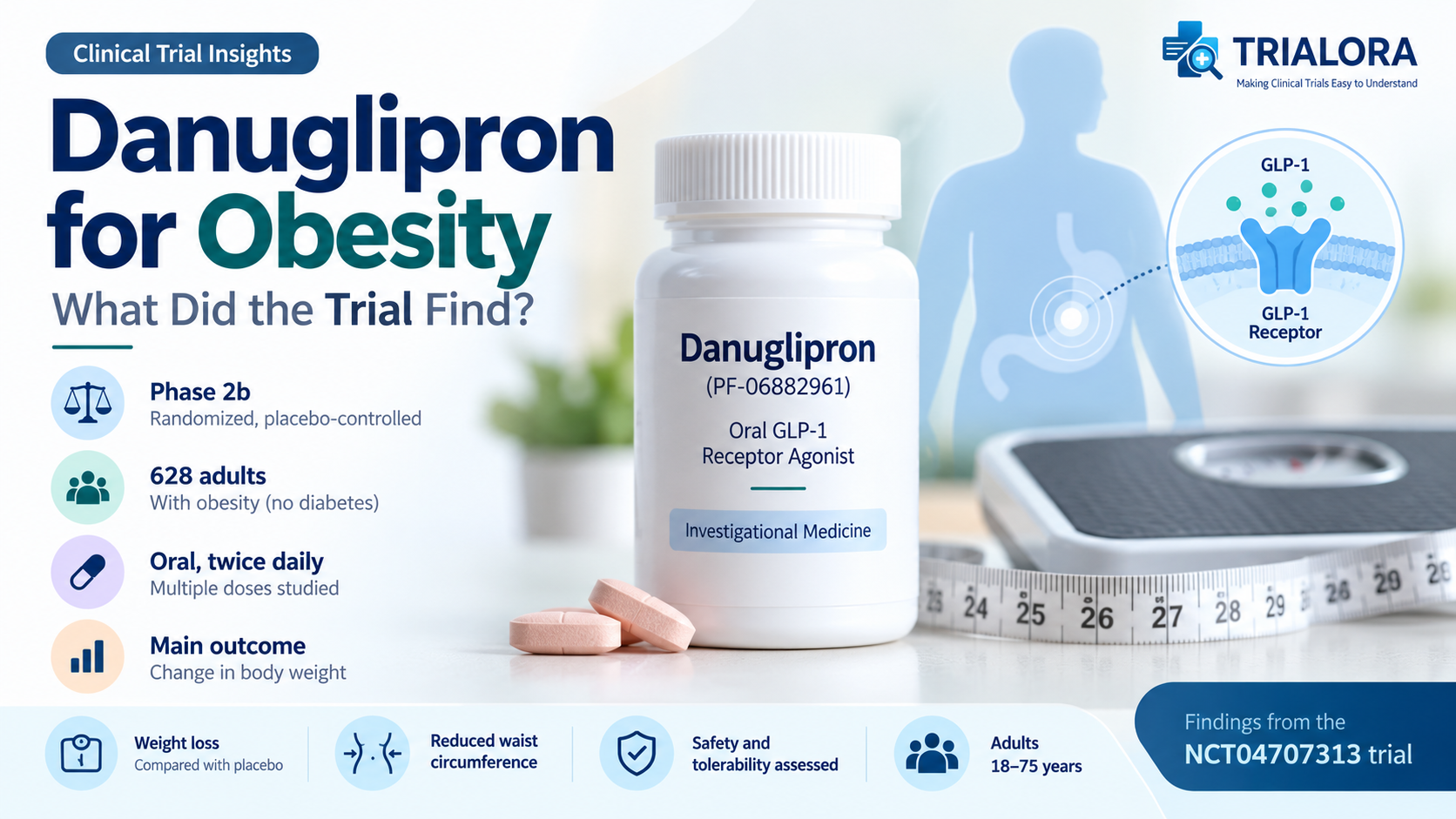
Researchers studied danuglipron (PF-06882961) as an oral medicine being investigated for adults with obesity.
The Phase 2b NCT04707313 clinical trial compared different doses of danuglipron with placebo in adults with obesity who did not have diabetes. The researchers mainly looked at changes in body weight, while also evaluating waist circumference, safety, and tolerability.
The study reported statistically significant reductions in body weight with the tested danuglipron groups compared with placebo. However, treatment discontinuation was common, particularly among participants receiving danuglipron. Gastrointestinal adverse events, including nausea and vomiting, were important safety findings.
Important: This article describes findings from one clinical trial. It is intended to explain the research and does not recommend danuglipron or any other treatment.
1. Danuglipron Trial at a Glance
| Study feature | Details |
| ClinicalTrials.gov ID | NCT04707313 |
| Study medicine | Danuglipron (PF-06882961) |
| Condition | Obesity |
| Study phase | Phase 2b |
| Participants randomized | 628 |
| Safety analysis | 626 participants |
| Age | 18–75 years |
| Comparator | Placebo |
| Administration | Oral, twice daily |
| Target doses | 40–200 mg twice daily |
| Treatment duration | 26 or 32 weeks |
| Countries | Canada, Japan, Taiwan, United States |
| Study period | January 29, 2021–October 11, 2023 |
| Primary outcome | Percentage change in body weight |
ClinicalTrials.gov lists 41 study locations, while the peer-reviewed publication reports that the study was conducted at 42 sites. Trialora reports this difference because the two sources do not match.
ClinicalTrials.gov describes the study as having quadruple masking, meaning the participant, care provider, investigator, and outcomes assessor were masked. The publication describes the treatment phase as double-blind.
2. Why Was Danuglipron Studied for Obesity?
The trial was designed to evaluate the effectiveness, safety, and tolerability of different doses of danuglipron in adults with obesity who did not have diabetes.
Participants were 18 to 75 years old and had a body mass index (BMI) of at least 30 kg/m². BMI is a measure based on height and weight that was used in this study to define obesity.
Participants also needed to have had a stable body weight before entering the study. People with type 1 or type 2 diabetes were excluded. The study also excluded people with several other medical conditions or characteristics specified in the trial’s eligibility criteria.
The researchers tested several target doses and different schedules for gradually increasing the dose. This allowed them to examine both weight loss and how participants tolerated different dosing approaches.
3. What Was Danuglipron and How Was It Given?
Danuglipron, also called PF-06882961, was an investigational medicine studied for obesity.
The peer-reviewed publication describes danuglipron as an oral, small-molecule glucagon-like peptide-1 (GLP-1) receptor agonist. In simple terms, it was an experimental medicine designed to act on the GLP-1 receptor.
Participants took danuglipron or placebo twice a day by mouth.
The trial evaluated several target doses:
- 40 mg twice daily
- 80 mg twice daily
- 120 mg twice daily
- 140 mg twice daily
- 160 mg twice daily
- 200 mg twice daily
Not every dose was used in every cohort. Different groups also used different schedules for gradually increasing the dose.
The sources reviewed for this article describe danuglipron as an investigational medicine. The publication also reports that Pfizer later discontinued its clinical development.
4. How Was the NCT04707313 Trial Designed?
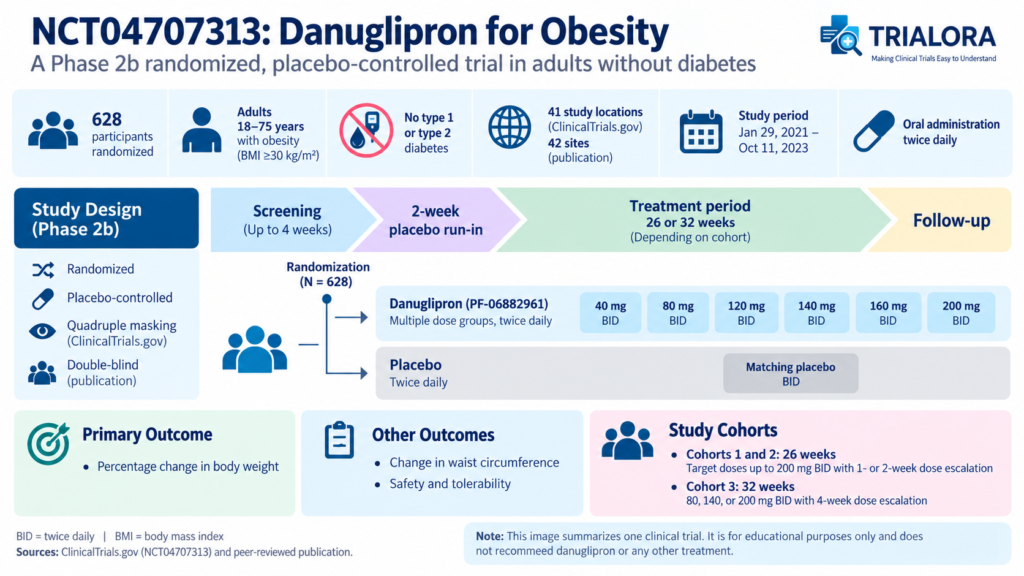
This was a randomized, placebo-controlled Phase 2b trial.
Randomized means participants were assigned to different treatment groups by chance. This helps reduce differences between groups that could affect the results.
A placebo is an inactive treatment designed to look like the study medicine. It gives researchers a comparison group for assessing whether changes are associated with the study medicine.
The trial included three cohorts:
| Cohort | Treatment period | Main dosing approach |
| Cohorts 1 and 2 | 26 weeks | Target doses up to 200 mg twice daily, with 1- or 2-week dose escalation |
| Cohort 3 | 32 weeks | 80, 140, or 200 mg twice daily, with 4-week dose escalation |
Participants first went through screening and a 2-week placebo run-in period. Those meeting the requirements were then randomized into the treatment phase.
The study began on January 29, 2021, and was completed on October 11, 2023. ClinicalTrials.gov reports an actual enrollment of 628 participants.
Study Design Schema
5. What Did Researchers Want to Find Out?
The main outcome was the percentage change in body weight from the beginning of treatment to the end of the treatment period.
For:
- Cohorts 1 and 2: body weight was assessed at Week 26
- Cohort 3: body weight was assessed at Week 32
The study also looked at whether participants achieved at least 5% weight loss, changes in waist circumference, and several safety measures.
These included adverse events, laboratory tests, vital signs, electrocardiograms (ECGs), and mental-health assessments.
A primary endpoint is the main outcome researchers use to determine whether a treatment had the intended effect.
In this trial, the primary endpoint focused on the change in body weight.
6. Did Danuglipron Help Participants Lose Weight?
The study reported statistically significant reductions in body weight with all tested danuglipron treatment groups compared with placebo.
“Statistically significant” means the difference observed in the study was unlikely to have occurred by chance alone. It does not mean that every individual participant experienced the same amount of weight loss.
Weight change compared with placebo
| Study group | Placebo-adjusted modelled mean reduction |
| Cohorts 1 and 2, Week 26 | Approximately 5.0% to 9.5% |
| Cohort 3, Week 32 | Approximately 8.2% to 12.9% |
These are modelled differences compared with placebo. They should not be interpreted as the exact percentage of weight lost by every participant.
In Cohorts 1 and 2, the reported range was approximately 5.0% to 9.5%.
In Cohort 3, the reported range was approximately 8.2% to 12.9%.
The researchers also reported that weight reductions appeared during the early weeks of treatment and generally did not plateau during the study period. Weight loss appeared somewhat slower early in treatment with the longer, 4-week dose-escalation schedule.
How many participants lost at least 5% of their weight?
A larger proportion of danuglipron-treated participants achieved at least 5% weight loss than placebo participants.
At Week 26:
- 48% to 80% of participants receiving danuglipron achieved at least 5% weight loss.
- 13% of placebo participants reached this level.
At Week 32:
- 64% to 88% of participants receiving danuglipron achieved at least 5% weight loss.
- 4% of placebo participants reached this level.
What happened to waist circumference?
Waist circumference also decreased more with danuglipron than with placebo.
At Week 26, placebo-adjusted differences in Cohorts 1 and 2 ranged from approximately −4.5 to −7.8 cm.
At Week 32, the corresponding differences in Cohort 3 ranged from approximately −6.5 to −11.6 cm.
7. What Side Effects and Safety Findings Were Reported?
Safety was an important part of the study because many participants stopped treatment before completing the planned treatment period.
The safety analysis included 626 participants who had received at least one dose of study intervention. Overall, 85.6% experienced at least one treatment-emergent adverse event.
- Danuglipron: 88.2%
- Placebo: 70.0%
An adverse event is an unwanted medical problem that occurs during a study. It does not necessarily mean that the study medicine caused the problem.
Most adverse events were reported as mild. Gastrointestinal problems, particularly nausea and vomiting, were the most common findings.
Gastrointestinal adverse events
Gastrointestinal adverse events occurred in:
- 77.4% of participants receiving danuglipron
- 30.0% receiving placebo
Among participants receiving danuglipron:
- 51.4% experienced nausea
- 31.3% experienced vomiting
The publication reported that gastrointestinal events generally became more common at higher target doses. Nausea and vomiting also tended to occur earlier with shorter dose-escalation schedules.
Serious adverse events and deaths
The study reported 19 participants (3.0%) with serious treatment-emergent adverse events.
One participant receiving 200 mg twice daily with 4-week dose escalation experienced serious adverse events of nausea and bilious vomiting that were considered related to study treatment.
No deaths were reported during NCT04707313.
Did participants stop treatment?
Treatment discontinuation was common:
- 61% discontinued treatment for any reason.
- 64% of participants receiving danuglipron discontinued.
- 39% of placebo participants discontinued.
- 38.5% (241 participants) discontinued because of adverse events from any cause.
- 33.2% (208 participants) discontinued because of treatment-related adverse events.
Gastrointestinal adverse events, especially nausea and vomiting, were the most common reasons for discontinuation. The publication also reported that discontinuations caused by adverse events were generally higher with higher target doses and shorter dose-escalation schedules.
8. What Were the Strengths, Limitations, and Later Developments?
Study strengths
The study had several useful features.
It was randomized and placebo-controlled and evaluated multiple danuglipron doses and dose-escalation schedules.
The treatment period lasted 26 or 32 weeks, providing more follow-up than some earlier danuglipron studies.
The study also focused specifically on adults with obesity without diabetes, allowing researchers to evaluate the medicine in that defined population.
Study limitations
The authors identified several limitations.
The most important was the high rate of treatment discontinuation. This created missing data at later time points. The authors also noted that the assumption that missing data were random might not have been completely valid.
Cohorts 2 and 3 were added through protocol amendments. They were therefore conducted at different times, and Cohort 3 had a longer treatment period.
The authors also noted some differences in baseline body weight between cohorts, potentially related to differences in geographic recruitment.
Finally, participants had to meet specific eligibility criteria and did not have diabetes. The findings therefore apply to the population studied rather than to every person with obesity.
What do these results mean?
In this Phase 2b trial, danuglipron was associated with statistically significant reductions in body weight compared with placebo across the tested dose groups.
At the same time, the study showed important tolerability challenges. Gastrointestinal adverse events were common, and treatment discontinuation was higher with danuglipron than with placebo.
The results therefore provide evidence about both weight change and tolerability with the dosing strategies studied. They do not show that every person with obesity would experience the same results.
What This Means for Patients
NCT04707313 provides information about an investigational oral medicine studied in a specific group of adults with obesity who did not have diabetes.
The study reported greater weight loss with danuglipron than placebo. However, many participants discontinued treatment, and gastrointestinal adverse events were common.
The findings should therefore be viewed in the context of both the reported weight changes and the treatment-discontinuation results.
The publication reports that Pfizer later discontinued clinical development of danuglipron after additional studies and review of clinical-trial information. This later development is separate from the results of NCT04707313.
What Happened to Danuglipron After This Trial?
NCT04707313 was completed on October 11, 2023.
The peer-reviewed publication reports that additional danuglipron studies were conducted after this Phase 2b trial. In one subsequent study, one asymptomatic participant experienced potential drug-induced liver injury.
Importantly, that event occurred in a subsequent study, not in NCT04707313.
The publication also reports that, after reviewing clinical-trial information and receiving regulatory input, Pfizer announced the discontinuation of clinical development of danuglipron.
Within NCT04707313 itself, the publication reported no danuglipron-treated participants with significantly elevated liver enzyme levels and no deaths.
9. Frequently Asked Questions
What is danuglipron?
Danuglipron, also known as PF-06882961, was an investigational oral medicine studied in adults with obesity. The publication describes it as a GLP-1 receptor agonist.
What was the NCT04707313 trial?
NCT04707313 was a randomized, placebo-controlled Phase 2b clinical trial that evaluated different doses of danuglipron in adults with obesity who did not have diabetes.
How many people participated?
628 participants were randomized. The safety analysis included 626 participants who received at least one dose of study intervention.
Did danuglipron reduce body weight?
The study reported statistically significant reductions in body weight with the tested danuglipron groups compared with placebo. The placebo-adjusted modelled mean reductions ranged from approximately 5.0% to 12.9%, depending on the cohort, dose, and treatment period.
What side effects were reported?
Gastrointestinal adverse events were common. The study reported nausea in 51.4% and vomiting in 31.3% of participants receiving danuglipron.
Did participants stop treatment?
Yes. Overall, 61% of participants discontinued treatment for any reason. The rate was 64% with danuglipron and 39% with placebo.
Were there deaths in the trial?
No deaths were reported during NCT04707313.
What happened to danuglipron after the trial?
The publication reports that additional studies were conducted after NCT04707313. It also reports that Pfizer later announced the discontinuation of clinical development of danuglipron.
10. Key Takeaways
- NCT04707313 studied danuglipron in adults with obesity without diabetes.
- 628 participants were randomized, with 626 included in the safety analysis.
- Weight loss was statistically greater with danuglipron than placebo across the tested dose groups.
- Placebo-adjusted modelled mean weight reductions ranged from approximately 5.0% to 12.9%.
- Gastrointestinal adverse events, especially nausea and vomiting, were common.
- 64% of danuglipron-treated participants discontinued treatment for any reason.
- No deaths were reported during the trial.
11. Funding and Transparency
The peer-reviewed publication states that the study was funded by Pfizer.
Trialora independently prepares educational content from publicly available clinical research information. Trialora is not affiliated with, funded by, sponsored by, or endorsed by Pfizer, the study investigators, ClinicalTrials.gov, or any regulatory authority, unless explicitly stated otherwise.
12. References
- Buckeridge C, Cobain S, Bays HE, Matsuoka O, Fukushima Y, Halstead P, Tsamandouras N, Sherry N, Gorman DN, Saxena AR. Efficacy and safety of danuglipron (PF-06882961) in adults with obesity: A randomized, placebo-controlled, dose-ranging phase 2b study. Diabetes Obesity and Metabolism. 2025;27(9):4915–4926. doi:10.1111/dom.16534.
- ClinicalTrials.gov. NCT04707313: A Study to Evaluate the Efficacy and Safety of PF-06882961 in Adults With Obesity. Clinical trial record and posted results.
- Pfizer. Pfizer provides update on oral GLP-1 receptor agonist danuglipron. 2025. This source is cited by the peer-reviewed publication in relation to the discontinuation of clinical development.
13. About This Article
This article explains the design, results, and findings of an individual clinical trial. It is based primarily on publicly available information from ClinicalTrials.gov and, where available, other supporting scientific or official sources referenced in the article.
Trialora independently prepares this content to help readers understand clinical trial information in clear and plain language. Trialora is not affiliated with, funded by, sponsored by, or endorsed by the study sponsor, investigators, ClinicalTrials.gov, or any regulatory authority, unless explicitly stated otherwise.
The information in this article reflects the study details and results available from the sources reviewed at the time of publication. Findings from one clinical trial should not automatically be considered applicable to every patient or population.
14. Trialora Promise
Every Trialora article is based primarily on publicly available evidence from ClinicalTrials.gov and other trusted scientific sources. Our mission is to explain complex clinical research in plain language while maintaining scientific accuracy, transparency, and objectivity.
Brand Motto: Making Clinical Trials Easy to Understand.
15. Medical Disclaimer
Medical Disclaimer: This article is intended for educational and informational purposes only. It summarizes findings from clinical research and should not be considered medical advice. Clinical trial results do not necessarily apply to every individual. Always consult a qualified healthcare professional before making decisions about your health or treatment.