ClinicalTrials.gov ID: NCT03570892
Study name: BELINDA
Study phase: Phase 3
Condition: Aggressive B-cell non-Hodgkin lymphoma
Study status: Completed
Quick Summary
The BELINDA trial studied whether a treatment strategy using tisagenlecleucel could improve outcomes compared with standard care in adults with aggressive B-cell non-Hodgkin lymphoma that had returned or had not responded to earlier treatment.
The main outcome was event-free survival, which measured how long participants remained without a defined event, such as disease progression, stable disease at or after the planned week-12 assessment, or death.
The median event-free survival was 3.0 months in both treatment groups. The primary analysis did not demonstrate superiority of the tisagenlecleucel treatment strategy over standard care.
The study also reported adverse events, serious adverse events, and all-cause mortality. Several planned secondary outcome results were not reported in the available ClinicalTrials.gov results record.
BELINDA Trial at a Glance
| Study detail | Information |
| Trial | BELINDA |
| ClinicalTrials.gov ID | NCT03570892 |
| Study phase | Phase 3 |
| Design | Randomized, open-label, multicenter |
| Actual enrollment | 330 |
| Full analysis set | 322 participants |
| Tisagenlecleucel group | 162 participants |
| Standard-of-care group | 160 participants |
| Countries and sites | 18 countries and 65 sites |
| Primary outcome | Event-free survival |
| Study status | Completed |
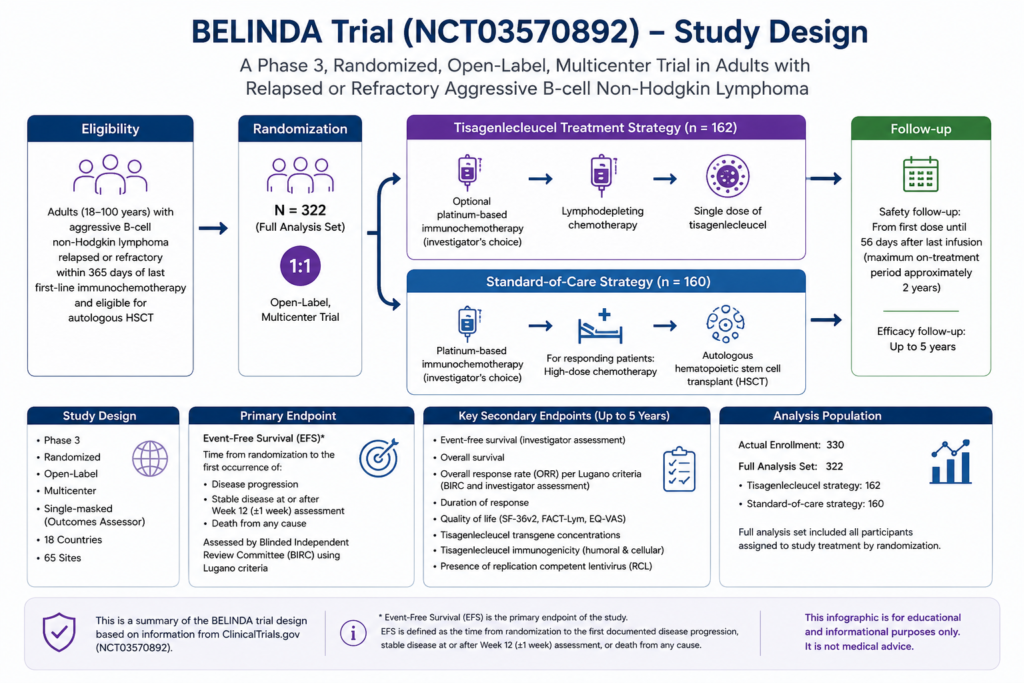
The study record reports 330 actual participants enrolled. However, the full analysis set included 322 participants: 162 in the tisagenlecleucel group and 160 in the standard-of-care group.
These numbers are different and should not be used interchangeably.
Study Design
Why Was the BELINDA Trial Conducted?
BELINDA enrolled adults with aggressive B-cell non-Hodgkin lymphoma whose disease had relapsed or was refractory within 365 days of their last first-line immunochemotherapy.
Relapsed means the disease returned after treatment.
Refractory means the disease did not respond adequately to treatment.
Participants also had to be eligible for an autologous hematopoietic stem cell transplant (HSCT). In this type of transplant, a person’s own stem cells are used.
Researchers compared a treatment strategy involving tisagenlecleucel with a standard-of-care treatment strategy.
What Treatments Did the BELINDA Trial Compare?
Tisagenlecleucel Treatment Strategy
Participants in this group could receive investigator-selected, optional platinum-based immunochemotherapy, followed by lymphodepleting chemotherapy and a single dose of tisagenlecleucel.
Tisagenlecleucel is a type of CAR-T cell therapy. CAR-T therapy uses a person’s own immune cells, called T cells, which are modified in a laboratory and then returned to the body.
Standard-of-Care Strategy
Participants in the comparison group received platinum-based immunochemotherapy. Those who responded could then receive high-dose chemotherapy followed by an autologous HSCT.
How Was the BELINDA Clinical Trial Designed?
BELINDA was a randomized, open-label, multicenter Phase 3 clinical trial.
Randomized means participants were assigned by chance to one of the treatment groups.
Open-label means participants and treating researchers knew which treatment strategy was being used.
The study also used a single-masked outcomes assessor. This means the person or group assessing the relevant study outcome was masked to treatment assignment.
The trial was conducted across 18 countries and 65 sites.
What Was the Main Outcome?
The primary endpoint was event-free survival (EFS).
A primary endpoint is the main outcome researchers use to answer the central question of a clinical trial.
In BELINDA, an event included:
- Disease progression
- Stable disease at or after the planned week-12 assessment
- Death from any cause
The primary outcome was assessed by a Blinded Independent Review Committee using Lugano criteria.
BELINDA Trial Results: Did Tisagenlecleucel Perform Better?
The main results were:
| Outcome | Tisagenlecleucel strategy | Standard-of-care strategy |
| Participants analyzed | 162 | 160 |
| Median event-free survival | 3.0 months | 3.0 months |
| 95% confidence interval | 2.9 to 4.2 months | 3.0 to 3.5 months |
The reported hazard ratio was 1.07, with a 95% confidence interval of 0.82 to 1.40. The reported p-value was 0.694.
A hazard ratio compares how often an event occurs between two groups over time.
A confidence interval provides a range around the estimated result.
The primary analysis was designed to test for superiority. Based on the reported results, the tisagenlecleucel treatment strategy did not demonstrate superiority over the standard-of-care strategy for event-free survival.
In simple terms, this study did not show that the tisagenlecleucel treatment strategy improved the primary outcome compared with standard care in the population studied.
What About Overall Survival and Other Outcomes?
The study listed several secondary outcomes, including:
- Overall survival
- Overall response rate
- Duration of response
- Event-free survival assessed by the local investigator
- Quality-of-life measures
- Tisagenlecleucel-related laboratory measurements
However, several secondary outcomes were listed as “Outcome Measure Data Not Reported” in the available ClinicalTrials.gov results record.
BELINDA Trial Safety Results
An adverse event is an unwanted medical problem that occurs during a clinical trial. An adverse event does not necessarily mean that the treatment caused the event.
The study reported the following overall safety results:
| Safety outcome | Tisagenlecleucel strategy | Standard-of-care strategy |
| Participants with any adverse event | 159/162 (98.15%) | 158/160 (98.75%) |
| Participants with serious adverse events | 76/162 (46.91%) | 82/160 (51.25%) |
| All-cause mortality | 52/162 (32.10%) | 45/160 (28.13%) |
A serious adverse event is an adverse event that meets specific criteria, such as being life-threatening, resulting in hospitalization, causing significant disability, or resulting in death.
The all-cause mortality figures report deaths from any cause within the study’s reported safety framework. These numbers should not be interpreted as showing that all reported deaths were caused by the assigned treatment.
The adverse-event tables included blood-related problems, infections, and other medical events.
Strengths of the BELINDA Trial
The BELINDA trial had several design features that support its ability to compare the two treatment strategies.
Randomized Phase 3 Design
Participants were randomly assigned to treatment strategies, allowing a direct comparison between the groups.
International, Multicenter Study
The study was conducted across 18 countries and 65 sites.
Independent Assessment of the Main Outcome
Although the trial was open-label, the primary outcome was assessed by a Blinded Independent Review Committee.
Substantial Analysis Population
The full analysis set included 322 participants.
Limitations of the BELINDA Trial
The available ClinicalTrials.gov results record does not provide a formal explanation for why the primary outcome was not met.
Therefore, this article does not speculate about the reason.
Another limitation is that several secondary outcome results were not reported in the available results record. This limits what can be concluded about outcomes such as overall survival and overall response rate from the source documents reviewed.
The study also compared two treatment strategies involving multiple treatment steps, rather than comparing one single medicine with one fixed comparator. This is important when interpreting the results.
What Do the BELINDA Trial Results Mean?
The BELINDA trial did not demonstrate superiority of the tisagenlecleucel treatment strategy over the standard-of-care strategy for its primary outcome, event-free survival.
The median event-free survival was 3.0 months in both groups.
These findings apply specifically to the participants, treatment strategies, and study design evaluated in BELINDA.
Key Takeaways
- BELINDA was a Phase 3 clinical trial in aggressive B-cell non-Hodgkin lymphoma.
- The study record reported 330 enrolled participants, while 322 were included in the full analysis set.
- The trial compared a tisagenlecleucel treatment strategy with standard care.
- Median event-free survival was 3.0 months in both groups.
- The primary analysis did not demonstrate superiority of the tisagenlecleucel strategy over standard care.
- Adverse events and serious adverse events were reported in both groups.
- Several secondary outcome results were not reported in the available ClinicalTrials.gov results record.
- The findings describe the results of this specific clinical trial and should not automatically be applied to every patient.
References
- ClinicalTrials.gov. Tisagenlecleucel in Adult Patients With Aggressive B-cell Non-Hodgkin Lymphoma (BELINDA). ClinicalTrials.gov Identifier: NCT03570892.
- ClinicalTrials.gov. BELINDA study details, participant flow, outcome measures, results, and adverse event reporting.
About This Article
This article explains the design, results, and findings of an individual clinical trial. It is based primarily on publicly available information from ClinicalTrials.gov and, where available, other supporting scientific or official sources referenced in the article.
Trialora independently prepares this content to help readers understand clinical trial information in clear and plain language. Trialora is not affiliated with, funded by, sponsored by, or endorsed by the study sponsor, investigators, ClinicalTrials.gov, or any regulatory authority, unless explicitly stated otherwise.
The information in this article reflects the study details and results available from the sources reviewed at the time of publication. Findings from one clinical trial should not automatically be considered applicable to every patient or population.
Medical Disclaimer
This article is intended for educational and informational purposes only. It summarizes findings from clinical research and should not be considered medical advice. Clinical trial results do not necessarily apply to every individual. Always consult a qualified healthcare professional before making decisions about your health or treatment.