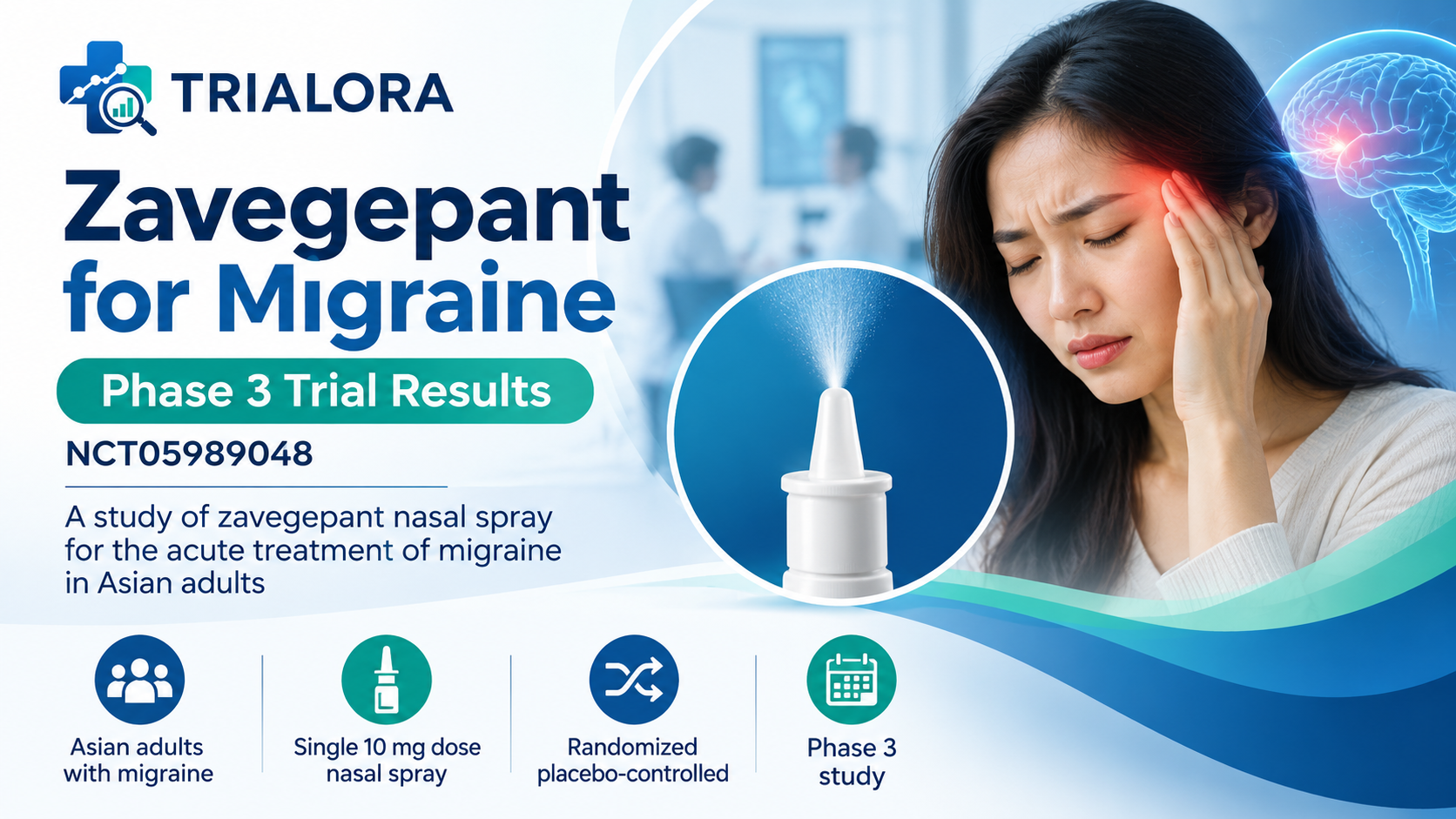
The Phase 3 NCT05989048 study evaluated zavegepant nasal spray for treating a single moderate or severe migraine attack in Asian adults. Researchers compared it with a placebo and measured pain freedom, relief from the most bothersome migraine symptom, other migraine outcomes, and safety.
Trial Snapshot
| Feature | Study information |
| Clinical trial | A Study to Learn About Zavegepant as the Acute Treatment of Migraine in Asian Adults |
| ClinicalTrials.gov ID | NCT05989048 |
| Sponsor | Pfizer |
| Phase | Phase 3 |
| Status | Completed |
| Treatment | Single 10 mg dose of intranasal zavegepant |
| Participants randomized | 1,414 |
Why Zavegepant was Studied for Migraine?
Migraine is a neurological condition that can cause moderate or severe head pain, nausea, and sensitivity to light or sound. These symptoms can interfere with everyday activities.
This study evaluated zavegepant as an acute migraine treatment—a treatment used to address an attack that is happening, rather than to prevent future attacks.
How Was Zavegepant Given?
Participants received one 10 mg dose of zavegepant nasal spray or a matching placebo for one moderate or severe migraine attack. The attack had to occur within 45 days after baseline or randomization.
A placebo is an inactive treatment that resembles the study treatment but contains no active medicine.
The study did not report this information about zavegepant’s biological mechanism.
How Was the Trial Designed?
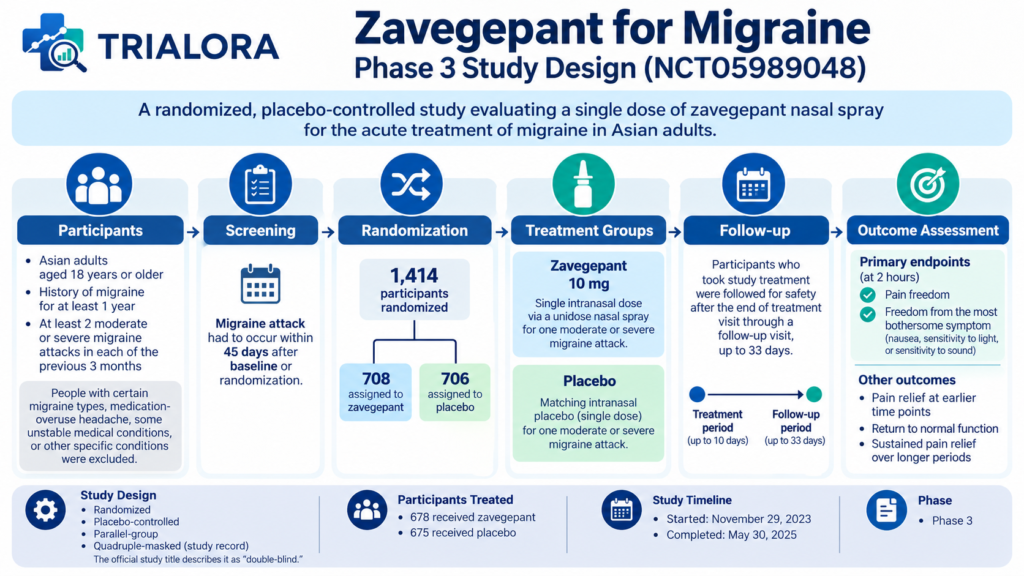
NCT05989048 was a randomized, placebo-controlled, parallel-group Phase 3 study. The structured design field identifies the study as quadruple-masked, meaning participants, care providers, investigators, and outcome assessors were kept unaware of the assigned treatment. The official study title uses the term “double-blind.”
- Randomized: Participants were assigned by chance to a treatment group.
- Placebo-controlled: Zavegepant was compared with a matching inactive treatment.
- Parallel-group: Participants remained in their assigned groups for the study comparison.
Of the 1,414 participants randomized, 708 were assigned to zavegepant and 706 to placebo. A total of 678 and 675 participants, respectively, received study treatment.
All 678 treated participants in the zavegepant group completed the treatment period, compared with 673 in the placebo group. In the placebo group, one participant withdrew and one was listed under “Other” as not completing the period. Another 31 participants in that group had been randomized but did not receive treatment; 30 randomized participants in the zavegepant group also did not receive treatment.
During follow-up, all 678 participants in the zavegepant group completed the period, compared with 673 in the placebo group. In the placebo group, one participant was lost to follow-up and one withdrew.
The study began on November 29, 2023, and was completed on May 30, 2025.
Who Took Part?
Participants were Asian adults aged 18 years or older with a history of migraine lasting at least one year. They also needed to have experienced at least two moderate or severe migraine attacks in each of the previous three months.
Eligibility criteria limited the number of moderate or severe attacks and headache days participants could have each month. Some preventive migraine medicines were allowed if their use had remained stable for at least three months.
People with certain migraine types, medication-overuse headache, some unstable medical conditions, or conditions that could interfere with nasal administration or study assessments were excluded.
These criteria define the population studied and limit how broadly the findings can be applied.
What Did Researchers Measure?
The trial had two primary endpoints, both assessed two hours after treatment. A primary endpoint is a main outcome used to answer a study’s central research question.
- Pain freedom: Whether the participant no longer had headache pain.
- Freedom from the most bothersome symptom: Whether the participant’s selected most bothersome symptom was absent. Participants selected nausea, sensitivity to light, or sensitivity to sound.
Researchers also measured pain relief at earlier time points, return to normal function, and whether pain relief continued over longer periods.
What Did the Trial Find?
Primary results at two hours
| Outcome | Zavegepant | Placebo | Difference between groups |
| Pain freedom | 23.2% | 14.1% | 9.2 percentage points |
| Freedom from the most bothersome symptom | 52.7% | 39.9% | 12.8 percentage points |
For pain freedom, the 95% confidence interval for the difference was 5.0 to 13.3 percentage points, with P<0.0001. For freedom from the most bothersome symptom, the interval was 7.5 to 18.1 percentage points, with P<0.0001.
A confidence interval describes the uncertainty around an estimated result. A P value helps assess how compatible the observed result is with a statistical model in which there is no true difference between groups. Neither measure alone establishes how meaningful a result is for an individual.
Other reported outcomes
| Outcome | Zavegepant | Placebo |
| Pain relief at 15 minutes | 14.5% | 10.9% |
| Pain relief at 30 minutes | 30.3% | 24.1% |
| Pain relief at 2 hours | 67.2% | 51.0% |
| Return to normal function at 2 hours | 38.0% | 24.4% |
| Sustained pain relief from 2 to 24 hours | 55.8% | 39.8% |
| Sustained pain relief from 2 to 48 hours | 53.3% | 38.6% |
Pain relief means a reduction in pain; it does not necessarily mean the person became completely pain-free. Sustained pain relief means relief continued over the specified period.
What Safety Findings Were Reported?
An adverse event is an unwanted medical occurrence during a study, whether or not it was caused by the treatment. A serious adverse event is an event that meets defined seriousness criteria, such as being life-threatening or requiring hospitalization.
| Safety measure | Zavegepant (678 participants) | Placebo (675 participants) |
| Participants with moderate or severe adverse events during treatment | 9 | 6 |
| Participants with moderate or severe adverse events during follow-up | 8 | 3 |
| Participants with serious adverse events during treatment | 2 | 1 |
| Participants with serious adverse events during follow-up | 3 | 0 |
| Deaths during treatment or follow-up | 0 | 0 |
The study also reported local irritation-related events during treatment in 41 participants in the zavegepant group and 6 in the placebo group. These events were associated with nasal administration and included altered taste, nasal discomfort, pain in the throat or mouth area, throat irritation, and laryngeal discomfort.
An adverse event reported during a trial is not automatically caused by the study treatment. These counts cover the specified treatment and follow-up periods.
What Were the Study’s Strengths and Limitations?
Strengths
- Random assignment and a placebo comparison allowed researchers to compare outcomes between groups.
- The study assessed two primary endpoints and several additional measures of pain relief and function.
Limitations
- The study evaluated a single dose for one migraine attack. It does not establish outcomes with repeated use across multiple attacks.
- Participants were Asian adults who met specific eligibility criteria. The findings may not represent every population or every person with migraine.
- The results cover the outcomes and observation periods measured in the trial and do not, on their own, establish longer-term outcomes.
What This Means for Patients
In this trial, the zavegepant group had higher rates of pain freedom and freedom from the most bothersome migraine symptom at two hours than the placebo group.
The study did not compare zavegepant with another active migraine medicine. Its findings therefore do not establish how it compares with treatments that were not studied or determine which treatment is suitable for an individual.
This article is for educational purposes and does not provide personal medical advice.
What Happens Next?
The study is completed and its results are reported. The study did not report this information about what additional studies, if any, will follow.
Reference
ClinicalTrials.gov. A Study to Learn About Zavegepant as the Acute Treatment of Migraine in Asian Adults. NCT05989048. View the study record.
Medical Disclaimer
This article is for educational purposes only and is not a substitute for professional medical advice, diagnosis, or treatment. Readers should speak with a qualified healthcare professional about individual medical questions.
Trialora Promise
Trialora explains clinical trial evidence in clear, balanced language. Our goal is to help readers understand what a study found, what its results mean, and what questions remain unanswered.