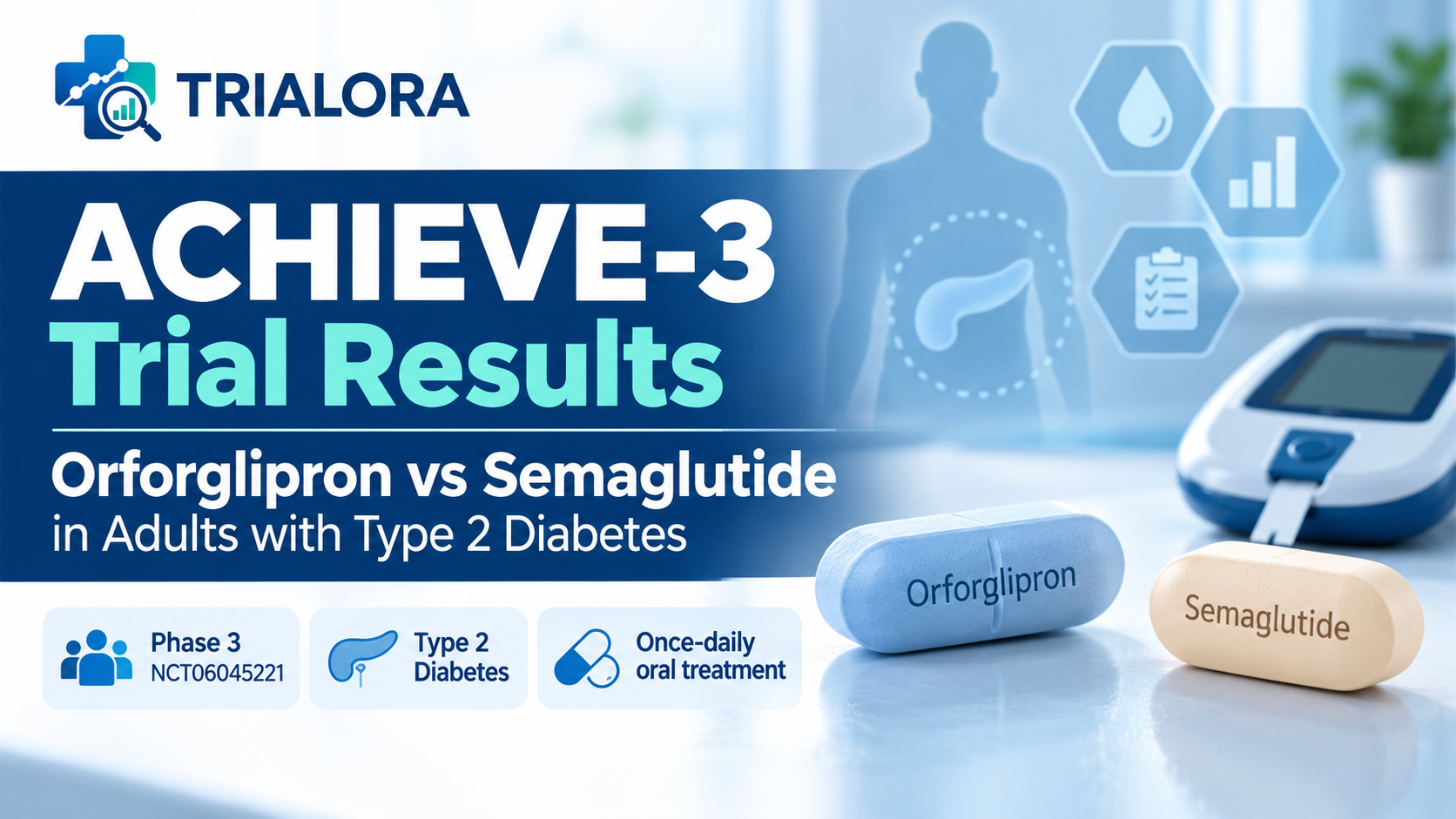
The ACHIEVE-3 trial compared once-daily oral orforglipron with oral semaglutide in adults with type 2 diabetes whose blood sugar was not adequately controlled with metformin.
The main question was whether orforglipron could reduce HbA1c, a measure of average blood sugar over time, by an amount that was not meaningfully worse than oral semaglutide.
ACHIEVE-3 Trial Snapshot
| Field | Information |
| Trial | ACHIEVE-3 |
| ClinicalTrials.gov ID | NCT06045221 |
| Condition | Type 2 diabetes |
| Treatment | Orforglipron |
| Comparator | Oral semaglutide |
| Sponsor | Eli Lilly and Company |
| Phase | Phase 3 |
| Participants enrolled | 1,698 |
| Status | Completed |
| Design | Randomized, parallel-group, open-label |
| Treatment period | 52 weeks |
| Primary endpoint | Change in HbA1c from baseline to Week 52 |
Why Was the ACHIEVE-3 Trial Conducted?
ACHIEVE-3 studied adults with type 2 diabetes whose blood sugar remained inadequately controlled while taking metformin.
Researchers wanted to directly compare two oral treatment approaches. The primary goal was to determine whether orforglipron could achieve similar blood-sugar control to oral semaglutide under the conditions tested.
Orforglipron is described as a non-peptide, small-molecule glucagon-like peptide-1 (GLP-1) receptor agonist. GLP-1 receptor agonists act on the GLP-1 receptor, a target involved in blood-sugar regulation and other metabolic processes.
The two treatments also differ in how they are taken. Orforglipron does not require the specific food and fluid restrictions associated with oral semaglutide.
How Were the Treatments Given?
Both treatments were taken once daily by mouth.
Participants receiving orforglipron started at 1 mg once daily. The dose was increased every four weeks until reaching either 12 mg or 36 mg once daily.
Participants receiving oral semaglutide started at 3 mg once daily. The dose was increased every four weeks until reaching either 7 mg or 14 mg once daily.
| Treatment | Starting dose | Target dose |
| Orforglipron | 1 mg once daily | 12 mg once daily |
| Orforglipron | 1 mg once daily | 36 mg once daily |
| Oral semaglutide | 3 mg once daily | 7 mg once daily |
| Oral semaglutide | 3 mg once daily | 14 mg once daily |
Treatment continued for 52 weeks.
How Was the Clinical Trial Designed?
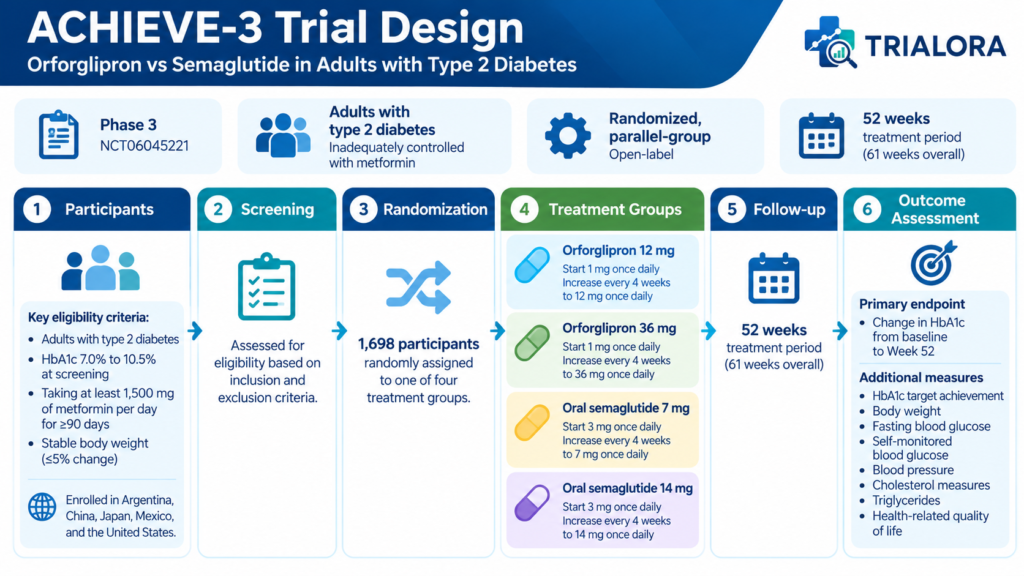
ACHIEVE-3 was a randomized, parallel-group, open-label clinical trial.
Participants were randomly assigned to one of four treatment groups. Randomization means treatment assignment is determined by a chance-based process rather than by the participant or investigator.
The trial was open-label, meaning participants and researchers knew which treatment was being given.
The study began in September 2023 and was completed in August 2025. The overall study was planned to last about 61 weeks, including the 52-week treatment period.
Who Participated?
The trial enrolled adults with type 2 diabetes.
Participants had to have an HbA1c between 7.0% and 10.5% at screening. They also needed to have been taking at least 1,500 mg of metformin per day for at least 90 days before screening and continue that treatment through randomization.
Participants needed stable body weight, defined in the trial as no more than a 5% change during the specified period before screening.
The study excluded people with type 1 diabetes and people with several specified medical conditions or circumstances. These included certain diabetic eye conditions requiring treatment, recent diabetic ketoacidosis or hyperosmolar coma, New York Heart Association class IV heart failure, specified reduced kidney function, elevated serum calcitonin, and certain active or recently treated cancers.
Participants were enrolled in Argentina, China, Japan, Mexico, and the United States.
What Did Researchers Measure?
The primary endpoint was the change in HbA1c from baseline to Week 52.
The main statistical question was whether orforglipron was non-inferior to oral semaglutide for reducing HbA1c.
Non-inferiority means researchers set a predefined limit for how much worse a new treatment could perform and still be considered sufficiently similar to the comparison treatment for the outcome being tested.
The primary comparisons were:
- 12 mg orforglipron versus 7 mg oral semaglutide
- 36 mg orforglipron versus 14 mg oral semaglutide
The non-inferiority margin was 0.3 percentage points of HbA1c.
The trial also evaluated HbA1c target achievement, body weight, fasting blood glucose, self-monitored blood glucose, blood pressure, cholesterol measures, triglycerides, and health-related quality of life.
What Did the ACHIEVE-3 Trial Find?
HbA1c Results
All four treatment groups had reductions in HbA1c by Week 52.
| Treatment | Change in HbA1c from baseline |
| 12 mg orforglipron | −1.91 percentage points |
| 36 mg orforglipron | −2.16 percentage points |
| 7 mg oral semaglutide | −1.11 percentage points |
| 14 mg oral semaglutide | −1.45 percentage points |
For 36 mg orforglipron versus 14 mg oral semaglutide, the adjusted treatment difference was −0.71 percentage points, with a 95% confidence interval of −0.86 to −0.55 and P<0.001.
For 12 mg orforglipron versus 7 mg oral semaglutide, the adjusted difference was −0.79 percentage points, with a 95% confidence interval of −0.96 to −0.62 and P<0.001.
Both primary comparisons met the predefined non-inferiority criterion.
A confidence interval gives a range around an estimated treatment difference and helps show how precisely that difference was measured.
The trial also reported statistically significant superiority for several prespecified HbA1c comparisons involving orforglipron.
HbA1c Target Achievement
At Week 52, the model-estimated percentages of participants achieving an HbA1c below 7.0% were:
| Treatment | HbA1c <7.0% |
| 12 mg orforglipron | 80.04% |
| 36 mg orforglipron | 85.41% |
| 7 mg oral semaglutide | 54.63% |
| 14 mg oral semaglutide | 66.12% |
The study also evaluated HbA1c levels of 6.5% or lower and below 5.7%.
Body-Weight Results
Body weight was a prespecified secondary outcome.
At Week 52, the reported adjusted mean changes in body weight were:
| Treatment | Change in body weight |
| 12 mg orforglipron | −6.7 kg |
| 36 mg orforglipron | −9.2 kg |
| 7 mg oral semaglutide | −3.7 kg |
| 14 mg oral semaglutide | −5.3 kg |
The trial also measured the percentage of participants achieving at least 5%, 10%, and 15% weight loss.
For the 15% threshold, the reported percentages were 11.99% with 12 mg orforglipron, 23.21% with 36 mg orforglipron, 4.99% with 7 mg semaglutide, and 6.45% with 14 mg semaglutide.
What Safety Findings Were Reported?
Safety follow-up continued for up to 57 weeks.
| Treatment | Serious adverse events | Deaths |
| 12 mg orforglipron | 21 of 424 | 1 |
| 36 mg orforglipron | 40 of 423 | 1 |
| 7 mg semaglutide | 19 of 426 | 2 |
| 14 mg semaglutide | 24 of 425 | 0 |
An adverse event is an unwanted medical event that occurs during a clinical trial. It does not necessarily mean that the treatment caused the event.
A serious adverse event is an event that meets specific criteria for seriousness, such as requiring hospitalization or involving another serious medical outcome.
Gastrointestinal adverse events were an important part of the safety findings and occurred more often with orforglipron than with semaglutide in the supporting analysis.
During the overall study period, discontinuation because of an adverse event occurred in 7 participants receiving 12 mg orforglipron, 4 receiving 36 mg orforglipron, 4 receiving 7 mg semaglutide, and 5 receiving 14 mg semaglutide.
The reported death counts alone do not establish that the deaths were caused by a study treatment.
What Were the Strengths of the Trial?
The randomized design helps reduce the risk that differences between treatment groups are explained by pre-existing differences between participants.
The study also used an active comparator rather than a placebo, allowing orforglipron to be compared directly with oral semaglutide.
The 52-week treatment period allowed researchers to examine changes in blood sugar and body weight over approximately one year.
What Are the Limitations?
The trial was open-label. Because participants and researchers knew which treatment was being given, expectations could potentially influence outcomes that depend on participant experience or reporting.
The trial compared specific doses of oral semaglutide: 7 mg and 14 mg. Higher doses of oral semaglutide have also been studied. Therefore, the ACHIEVE-3 findings should be interpreted as comparisons with the semaglutide doses tested in this trial rather than with every possible oral semaglutide dose.
The 52-week treatment period provides information over approximately one year but does not establish long-term durability, rare adverse effects, or long-term cardiovascular and kidney outcomes.
What Do the ACHIEVE-3 Results Mean?
ACHIEVE-3 met its primary statistical objective. Both primary dose-matched comparisons met the predefined non-inferiority criteria for HbA1c reduction.
The trial also reported statistically significant superiority for several prespecified comparisons involving HbA1c and body weight.
However, statistical superiority for individual outcomes does not automatically establish overall clinical superiority.
Overall treatment value can also depend on tolerability, ability to continue treatment, patient preferences, and longer-term health outcomes. These broader questions were not fully answered by this trial.
The trial did not include dedicated measurements of body composition or muscle function. Therefore, it does not establish how the observed weight loss affected lean mass or muscle function.
What This Means for Patients
ACHIEVE-3 provides evidence from a randomized Phase 3 trial of two oral treatment approaches for adults with type 2 diabetes whose blood sugar was not adequately controlled with metformin.
The findings come from participants who met specific eligibility requirements and received the doses and treatment schedules tested in the trial.
The results provide information about blood-sugar control, body-weight changes, and safety during the study period. They do not establish that one treatment is appropriate for every person.
What’s Next?
ACHIEVE-3 is completed. The study ended in August 2025, and results were posted to ClinicalTrials.gov in September 2026.
Important questions remain about longer-term safety and tolerability, treatment persistence, cardiovascular and kidney outcomes, body composition, and other outcomes that require longer follow-up.
Anonymized individual participant-level data may be made available through a secure access environment after approval of a research proposal and a signed data-sharing agreement. The available data types include the study protocol, statistical analysis plan, and clinical study report.
References
- ClinicalTrials.gov. A Study of Orforglipron (LY3502970) Compared With Semaglutide in Participants With Type 2 Diabetes Inadequately Controlled With Metformin. ClinicalTrials.gov Identifier: NCT06045221. Sponsor: Eli Lilly and Company.
- Rosenstock J, Yabe D, Cox D, Li J, Denning M, Wu WS, Liu R, Zhao Y; ACHIEVE-3 Investigators. Efficacy and safety of once-daily oral orforglipron compared with oral semaglutide in adults with type 2 diabetes (ACHIEVE-3): a multinational, multicentre, non-inferiority, open-label, randomised, phase 3 trial. The Lancet. 2026;407(10534):1147–1160. doi:10.1016/S0140-6736(26)00202-3.
- Bernasconi D, Lunati ME, Fiorina P. Orforglipron versus oral semaglutide in type 2 diabetes, clinical implications of the ACHIEVE-3 trial. Metabolism and Target Organ Damage. 2026;6:57. doi:10.20517/mtod.2026.142.
About This Article
This article explains the design, results, and findings of the ACHIEVE-3 clinical trial. It is based primarily on publicly available clinical trial information and supporting scientific publications.
Trialora independently prepares this content to help readers understand clinical trial information in clear and plain language. Trialora is not affiliated with, funded by, sponsored by, or endorsed by the study sponsor, investigators, ClinicalTrials.gov, or any regulatory authority, unless explicitly stated otherwise.
The information in this article reflects the study details and results available from the sources reviewed at the time of publication. Findings from one clinical trial should not automatically be considered applicable to every patient or population.
Trialora Promise
Every Trialora article is based primarily on publicly available evidence from ClinicalTrials.gov and other trusted scientific sources. Our mission is to explain complex clinical research in plain language while maintaining scientific accuracy, transparency, and objectivity.
Making Clinical Trials Easy to Understand.
Evidence-Based | Plain Language | Trusted Information
Medical Disclaimer
This content is intended for educational purposes only and should not be considered medical advice. Always consult a qualified healthcare professional regarding medical decisions.