The SUMMIT trial (NCT04847557) studied tirzepatide in adults with heart failure with preserved ejection fraction (HFpEF) and obesity.
This Phase 3 trial compared once-weekly tirzepatide with placebo. A total of 731 participants were randomized, with 364 receiving tirzepatide and 367 receiving placebo. The median follow-up was 104 weeks.
The study found fewer first occurrences of the combined outcome of cardiovascular death or worsening heart failure with tirzepatide. Participants receiving tirzepatide also had greater improvement in heart-failure-related health status, body weight, and six-minute walking distance.
At the same time, adverse events leading to treatment discontinuation were more frequent with tirzepatide, mainly because of gastrointestinal events.
Important: This article explains findings from the SUMMIT clinical trial. It is not a recommendation to use tirzepatide.
SUMMIT Trial at a Glance
| Study feature | Details |
| ClinicalTrials.gov ID | NCT04847557 |
| Study name | SUMMIT |
| Condition | Heart failure with preserved ejection fraction and obesity |
| Study phase | Phase 3 |
| Participants randomized | 731 |
| Tirzepatide group | 364 |
| Placebo group | 367 |
| Study design | Randomized, double-blind, placebo-controlled, parallel-group |
| Treatment | Tirzepatide once weekly |
| Maximum dose | 15 mg weekly or maximum tolerated dose |
| Median follow-up | 104 weeks |
| Study status | Completed |
| ClinicalTrials.gov results posted | Yes |
| Study Sponsor | Eli Lilly and Company |
ClinicalTrials.gov identifies the study as a randomized, parallel-assignment, double-masked Phase 3 interventional trial. The study started on April 20, 2021, and completed on July 2, 2024.
Why Was the SUMMIT Trial Conducted?
HFpEF is a form of heart failure in which the left ventricle has an ejection fraction of at least 50%. Ejection fraction describes the percentage of blood pumped out of the heart’s main pumping chamber with each heartbeat.
People with HFpEF can still have significant symptoms and reduced physical ability even when this pumping percentage is preserved.
The SUMMIT trial focused specifically on people who had both HFpEF and obesity. The researchers wanted to determine whether tirzepatide could improve important heart-failure outcomes and patient-reported health status in this population.
The study’s main goals were to examine a combined outcome of cardiovascular death or worsening heart failure and changes in the Kansas City Cardiomyopathy Questionnaire Clinical Summary Score (KCCQ-CSS).
What Is HFpEF With Obesity?
Heart failure with preserved ejection fraction (HFpEF) occurs when the heart’s pumping percentage remains preserved, but the heart has difficulty filling properly.
In SUMMIT, participants had stable, chronic heart failure classified as New York Heart Association (NYHA) class II–IV. NYHA class describes how much heart failure limits physical activity.
Participants also had a body-mass index (BMI) of at least 30 kg/m², which was the study’s definition of obesity.
The trial included additional requirements designed to confirm HFpEF and establish functional limitation. For example, participants needed a six-minute walking distance between 100 and 425 meters and a KCCQ-CSS of 80 or lower.
What Is Tirzepatide?
Tirzepatide is a medicine that acts on two hormone receptors: the glucose-dependent insulinotropic polypeptide (GIP) receptor and the glucagon-like peptide-1 (GLP-1) receptor.
In SUMMIT, tirzepatide was given as a subcutaneous injection once a week. Participants started at 2.5 mg weekly. The dose was increased by 2.5 mg every four weeks, up to 15 mg weekly or the participant’s maximum tolerated dose.
The comparison group received matching placebo injections. A placebo is an inactive treatment designed to look like the study treatment. It allows researchers to compare outcomes without the active medicine.
How Was the SUMMIT Trial Designed?
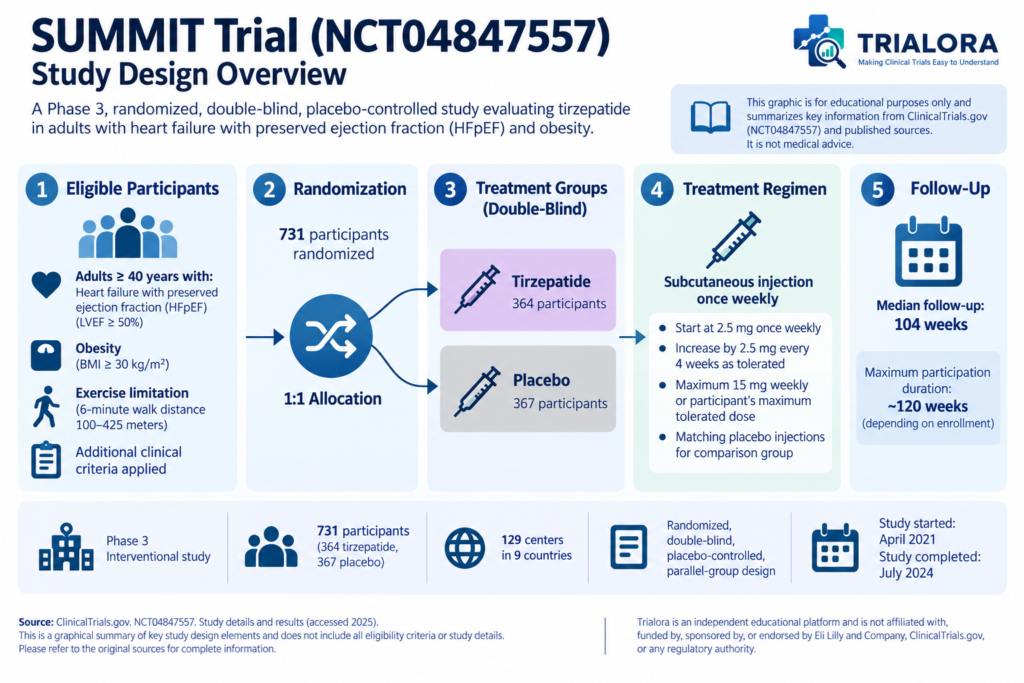
SUMMIT was a Phase 3, randomized, double-blind, placebo-controlled trial.
- Randomized: Participants were assigned by chance to the treatment groups.
- Double-blind: Participants and investigators did not know which treatment had been assigned.
- Placebo-controlled: The comparison group received an inactive treatment.
- Parallel-group: Participants remained in their assigned treatment group.
The trial randomized 731 participants and followed them for a median of 104 weeks after they started the study treatment.
Study Design
| Feature | What it means in SUMMIT |
| Phase | Phase 3 |
| Allocation | Randomized |
| Masking | Double-blind |
| Comparator | Placebo |
| Treatment | Tirzepatide |
| Dosing | Once weekly |
| Participants | 731 |
| Median follow-up | 104 weeks |
Who Participated?
Participants were 40 years or older and had stable heart failure classified as NYHA class II–IV. Their left ventricular ejection fraction was at least 50%.
They also had obesity, defined as BMI ≥30 kg/m².
Other eligibility requirements included evidence supporting HFpEF, functional limitation, and either recent heart-failure decompensation or reduced estimated kidney filtration. Heart-failure medications had to be stable before screening.
Some people were excluded, including those with recent major cardiovascular events, recent acute worsening of heart failure, certain other causes of functional limitation, severe valvular disease, a history of pancreatitis, or severe kidney impairment requiring dialysis.
ClinicalTrials.gov lists study locations in Argentina, Brazil, China, India, Israel, Mexico, Puerto Rico, Russia, Taiwan, and the United States. The peer-reviewed publication describes the trial as being conducted at 129 centers in nine countries.
What Did Researchers Want to Find Out?
The study had two primary outcomes.
The first was a combined measure of cardiovascular death or worsening heart failure. A combined outcome means that researchers count more than one type of event together.
The second was change in the KCCQ-CSS at Week 52. The KCCQ is a patient questionnaire that measures how heart failure affects symptoms and physical limitations. Scores range from 0 to 100, with higher scores representing better health status.
Researchers also examined several secondary outcomes, including:
- Body-weight change
- Six-minute walking distance
- Heart-failure events
- NYHA functional class
- Other clinical outcomes and safety measures
Did Tirzepatide Improve Outcomes?
Fewer Cardiovascular Death or Worsening Heart-Failure Events
During follow-up, the combined outcome of cardiovascular death or worsening heart failure occurred in:
| Outcome | Tirzepatide | Placebo |
| Cardiovascular death or worsening HF | 36 (9.9%) | 56 (15.3%) |
| Hazard ratio | 0.62 | — |
| 95% confidence interval | 0.41–0.95 | — |
| P value | 0.026 | — |
A hazard ratio (HR) compares how often an event occurs between two groups over time. An HR below 1 means the event occurred less often in the treatment group than in the comparison group.
Here, the hazard ratio of 0.62 indicates a lower rate of the combined outcome with tirzepatide than placebo during the study period. The 95% confidence interval was 0.41 to 0.95, and the reported P value was 0.026.
The individual components should be considered separately. Worsening heart-failure events occurred in 29 participants (8.0%) receiving tirzepatide and 52 (14.2%) receiving placebo.
Cardiovascular death occurred in 8 participants (2.2%) in the tirzepatide group and 5 (1.4%) in the placebo group. The hazard ratio for cardiovascular death alone was 1.58, with a 95% confidence interval of 0.52 to 4.83.
Health Status Improved More With Tirzepatide
At Week 52, the mean KCCQ-CSS increased by:
- 19.5 points with tirzepatide
- 12.7 points with placebo
The between-group difference was 6.9 points, with a 95% confidence interval of 3.3 to 10.6 and P<0.001.
In simple terms, participants receiving tirzepatide reported a greater improvement in heart-failure-related health status than those receiving placebo.
Other Results at Week 52
| Outcome | Tirzepatide | Placebo | Between-group difference |
| KCCQ-CSS change | +19.5 points | +12.7 points | +6.9 points |
| Body weight change | −13.9% | −2.2% | −11.6 percentage points |
| Six-minute walk distance | +26.0 m | +10.1 m | +18.3 m |
| hsCRP change | −38.8% | −5.9% | −34.9 percentage points |
All four between-group differences shown above had P<0.001 in the main peer-reviewed publication.
The six-minute walk test measures how far a participant can walk during six minutes. In SUMMIT, walking distance increased more with tirzepatide.
High-sensitivity C-reactive protein (hsCRP) is a blood marker used in the study to assess inflammation. Its level decreased more with tirzepatide.
These findings describe the participants enrolled in SUMMIT. They do not establish that every person with HFpEF and obesity would experience the same results.
What Side Effects Were Reported?
An adverse event is any unwanted medical problem reported during a clinical trial, whether or not it was caused by the treatment.
ClinicalTrials.gov reported serious adverse events in:
| Safety outcome | Tirzepatide | Placebo |
| Serious adverse events | 96/364 (26.37%) | 94/367 (25.61%) |
| Death from any cause | 19/364 (5.22%) | 15/367 (4.09%) |
A serious adverse event is an event meeting regulatory seriousness criteria, such as hospitalization, a life-threatening event, disability, or death.
The main peer-reviewed publication reported that adverse events leading to treatment discontinuation were mainly gastrointestinal.
Treatment was discontinued because of adverse events in:
- 23 participants (6.3%) receiving tirzepatide
- 5 participants (1.4%) receiving placebo
ClinicalTrials.gov also reported gastrointestinal adverse events including nausea, vomiting, diarrhea, constipation, dyspepsia, and upper abdominal pain.
The all-cause mortality figures are different from the cardiovascular-death figures reported for the primary composite outcome. They should not be treated as the same endpoint.
What Were the Strengths of the SUMMIT Trial?
The study had several important design strengths.
It was randomized, double-blind, and placebo-controlled, which helps reduce differences between treatment groups and the influence of expectations.
The trial included 731 participants and had a median follow-up of 104 weeks. The main publication also reports enrollment across 129 centers.
The study assessed several types of outcomes, including clinical heart-failure events, patient-reported health status, walking ability, and body weight.
Together, these features allowed researchers to examine the treatment from several perspectives rather than relying on one measurement alone.
What Were the Limitations?
The available publications identify an important limitation concerning the duration of some patient-reported and functional assessments.
Although participants were followed for longer-term clinical outcomes, measures such as KCCQ-CSS, six-minute walk distance, quality of life, and NYHA functional class were assessed at specific time points, including 24 and 52 weeks.
Zile and colleagues noted that further study was needed to determine whether improvements in symptoms, health status, exercise capacity, and quality of life remain durable beyond one year.
Another limitation is the study population itself. Participants had specific HFpEF, obesity, functional, and medical eligibility characteristics. Therefore, the results should be understood in the context of the population studied.
What Do the SUMMIT Results Mean?
The main SUMMIT results provide evidence that tirzepatide was associated with a lower rate of the combined outcome of cardiovascular death or worsening heart failure in the studied population.
The study also found greater improvements in heart-failure-related health status, body weight, and six-minute walking distance compared with placebo.
However, the result for the combined cardiovascular-death/worsening-heart-failure endpoint should not be interpreted as evidence that tirzepatide reduced cardiovascular deaths by itself. Cardiovascular death alone was reported in 8 participants receiving tirzepatide and 5 receiving placebo, with a hazard ratio of 1.58 and a wide confidence interval.
Safety findings also matter. Serious adverse-event rates were similar between groups, while adverse events leading to treatment discontinuation occurred more often with tirzepatide.
The most accurate interpretation is therefore balanced: SUMMIT reported favorable differences across several measured outcomes, alongside a higher rate of treatment discontinuation because of adverse events.
What This Means for Patients
SUMMIT provides clinical-trial evidence about how tirzepatide performed in adults with HFpEF and obesity who met the study’s eligibility criteria.
The findings included fewer combined cardiovascular-death or worsening-heart-failure events and greater improvements in patient-reported health status, weight, and walking distance.
At the same time, adverse events leading to treatment discontinuation were more common with tirzepatide.
These findings describe the study population and should not be treated as a prediction of what will happen to an individual person.
What’s Next?
ClinicalTrials.gov lists SUMMIT as completed, with results posted. The study’s final data collection date for the primary outcome was July 2, 2024.
The peer-reviewed analysis by Zile and colleagues states that further study is needed to determine how durable some improvements in symptoms, health status, exercise capacity, and quality of life are beyond one year.
Frequently Asked Questions
What was the SUMMIT trial?
SUMMIT was a Phase 3 randomized, double-blind, placebo-controlled trial evaluating tirzepatide in adults with HFpEF and obesity. 731 participants were randomized.
What is NCT04847557?
NCT04847557 is the ClinicalTrials.gov identifier for the SUMMIT trial. ClinicalTrials.gov lists the study as completed with results posted.
Did tirzepatide reduce worsening heart failure?
The study found fewer first occurrences of the combined outcome of cardiovascular death or worsening heart failure with tirzepatide than with placebo. The reported hazard ratio was 0.62.
Did participants lose weight?
Yes. At Week 52, mean body weight decreased by 13.9% with tirzepatide compared with 2.2% with placebo.
What side effects were reported?
Gastrointestinal adverse events, including nausea, vomiting, diarrhea, constipation, dyspepsia, and upper abdominal pain, were reported in the ClinicalTrials.gov results.
Did people stop treatment because of adverse events?
Yes. Treatment discontinuation because of adverse events occurred in 6.3% of participants receiving tirzepatide and 1.4% receiving placebo.
Were deaths reported?
Yes. ClinicalTrials.gov reported 19 deaths from any cause in the tirzepatide group and 15 in the placebo group. Cardiovascular deaths were reported separately as 8 and 5, respectively.
Key Takeaways
- SUMMIT (NCT04847557) randomized 731 participants with HFpEF and obesity.
- Tirzepatide was associated with fewer combined cardiovascular-death or worsening-heart-failure events.
- Health status, body weight, and six-minute walking distance improved more with tirzepatide at the reported assessment points.
- Serious adverse-event rates were similar between groups.
- Adverse events leading to treatment discontinuation were more common with tirzepatide.
- Cardiovascular death alone was not clearly different between groups.
- Further research is needed to assess the durability of some functional and patient-reported improvements beyond one year.
Funding and Transparency
ClinicalTrials.gov identifies Eli Lilly and Company as the sponsor of NCT04847557. The main peer-reviewed publication states that the SUMMIT trial was funded by Eli Lilly and Company.
The published research also identifies the authors and SUMMIT Trial Study Group. Trialora independently prepares educational content from publicly available clinical research information.
Trialora is not affiliated with, funded by, sponsored by, or endorsed by Eli Lilly and Company, the study investigators, ClinicalTrials.gov, or any regulatory authority, unless explicitly stated otherwise.
References
- ClinicalTrials.gov. NCT04847557. A Study of Tirzepatide (LY3298176) in Participants With Heart Failure With Preserved Ejection Fraction (HFpEF) and Obesity: The SUMMIT Trial. Clinical trial record and posted results.
- Packer M, Zile MR, Kramer CM, et al. Tirzepatide for Heart Failure with Preserved Ejection Fraction and Obesity. New England Journal of Medicine. 2025;392:427–437. doi:10.1056/NEJMoa2410027.
- Zile MR, Borlaug BA, Kramer CM, et al. Effects of Tirzepatide on the Clinical Trajectory of Patients With Heart Failure, Preserved Ejection Fraction, and Obesity. Circulation. 2025;151:656–668. doi:10.1161/CIRCULATIONAHA.124.072679.
- Borlaug BA, Zile MR, Kramer CM, et al. Effects of tirzepatide on circulatory overload and end-organ damage in heart failure with preserved ejection fraction and obesity: a secondary analysis of the SUMMIT trial. Nature Medicine. 2025;31:544–551. doi:10.1038/s41591-024-03374-z.
- Kramer CM, Borlaug BA, Zile MR, et al. Tirzepatide Reduces LV Mass and Paracardiac Adipose Tissue in Obesity-Related Heart Failure: SUMMIT CMR Substudy. Journal of the American College of Cardiology. 2025;85:699–706. doi:10.1016/j.jacc.2024.11.001.
Trialora Promise
Every Trialora article is based primarily on publicly available evidence from ClinicalTrials.gov and other trusted scientific sources. Our mission is to explain complex clinical research in plain language while maintaining scientific accuracy, transparency, and objectivity.
Brand Motto: Making Clinical Trials Easy to Understand.
About This Article
This article explains the design, results, and findings of an individual clinical trial. It is based primarily on publicly available information from ClinicalTrials.gov and, where available, other supporting scientific or official sources referenced in the article.
Trialora independently prepares this content to help readers understand clinical trial information in clear and plain language. Trialora is not affiliated with, funded by, sponsored by, or endorsed by the study sponsor, investigators, ClinicalTrials.gov, or any regulatory authority, unless explicitly stated otherwise.
The information in this article reflects the study details and results available from the sources reviewed at the time of publication. Findings from one clinical trial should not automatically be considered applicable to every patient or population.
Medical Disclaimer
Medical Disclaimer: This article is intended for educational and informational purposes only. It summarizes findings from clinical research and should not be considered medical advice. Clinical trial results do not necessarily apply to every individual. Always consult a qualified healthcare professional before making decisions about your health or treatment.