Reading time: About 8 minutes
Aneurysmal subarachnoid hemorrhage is a serious type of bleeding around the brain. Even after the initial bleeding is treated, some people can develop further problems when blood flow to parts of the brain becomes reduced.
The REACT trial studied whether clazosentan could help prevent one of these complications. The main result was that clazosentan did not significantly reduce the study’s primary outcome compared with placebo. Some additional outcomes differed between the groups, but these findings did not change the main result.
Study Information
| Study Detail | Information |
| Trial name | REACT |
| ClinicalTrials.gov ID | NCT03585270 |
| Study phase | Phase 3 |
| Condition studied | Aneurysmal subarachnoid hemorrhage |
| Sponsor | Idorsia Pharmaceuticals Ltd. |
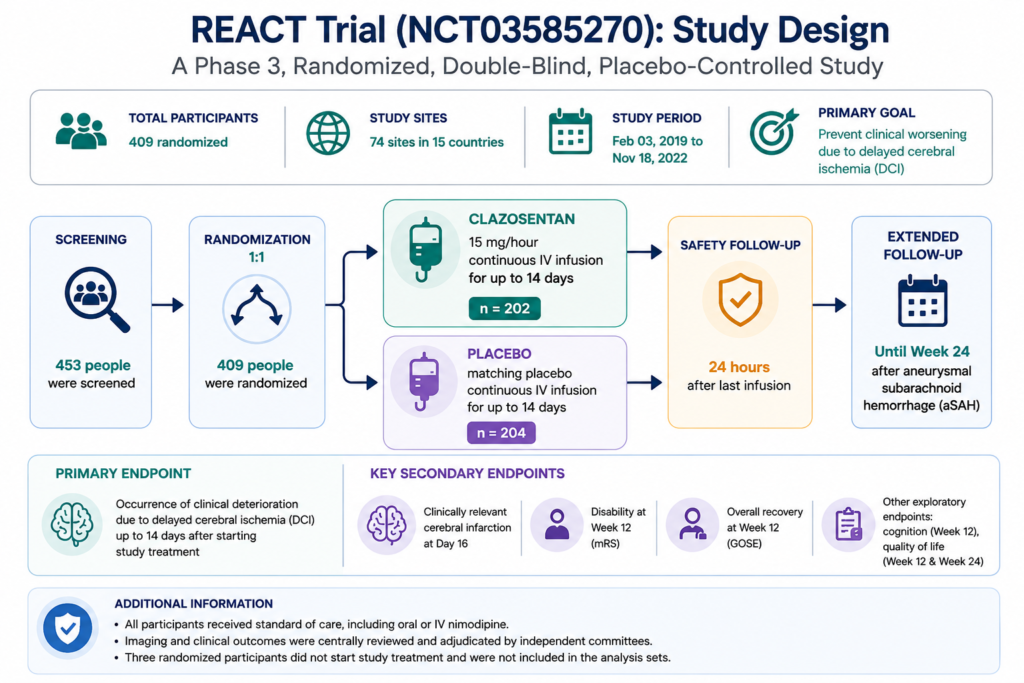
| Participants randomized | 409 |
| Study design | Randomized, double-blind, placebo-controlled |
| Treatment | Clazosentan 15 mg/hour by continuous intravenous infusion |
| Comparator | Matching placebo |
| Treatment period | Up to 14 days |
| Follow-up | Safety follow-up for 24 hours, with extended follow-up to Week 24 after the bleeding event |
| Primary outcome | Clinical worsening caused by delayed cerebral ischemia during the first 14 days after starting treatment |
| Study status | Completed |
ClinicalTrials.gov reports that 453 people were screened and 409 were enrolled and randomly assigned to study treatment.
Study Design
Why Was This Study Done?
Aneurysmal subarachnoid hemorrhage, often shortened to aSAH, happens when an aneurysm bursts and causes bleeding around the brain.
An aneurysm is a weak or bulging area in a blood vessel. When it bursts, blood can enter the space surrounding the brain.
After this type of bleeding, some people may develop cerebral vasospasm, which means that blood vessels in the brain become narrower. This can reduce blood flow and may contribute to further brain injury.
Another serious complication is called delayed cerebral ischemia, or DCI. In simple terms, this means that reduced blood flow after the original bleeding can lead to worsening brain function.
Researchers wanted to find out whether clazosentan, given alongside routine medical care, could reduce the risk of these complications.
What Is Clazosentan?
Clazosentan is a medicine that blocks endothelin receptors. Endothelin is involved in the narrowing of blood vessels.
Researchers studied whether blocking this pathway could help reduce complications related to blood vessel narrowing after aneurysmal subarachnoid hemorrhage.
In REACT, clazosentan was given through a vein as a continuous infusion at 15 mg per hour for up to 14 days.
How Was the REACT Trial Conducted?
REACT was a Phase 3 clinical trial. Phase 3 studies usually involve larger groups of participants and help researchers understand how well a treatment works and gather further safety information.
The trial used several methods to make the comparison between treatments as fair as possible.
Participants were randomly assigned
Participants were assigned by chance to receive either:
- Clazosentan, or
- A matching placebo
A placebo is a treatment that does not contain the active study medicine and is used as a comparison.
The study was double-blind
The study was conducted in a blinded manner. Participants and the people involved in the study did not know which treatment a participant received during the blinded treatment period.
Blinding is used to help reduce bias when treatments are compared.
Who was included in the main analysis?
Of the 409 people who were randomized:
- 203 were assigned to clazosentan.
- 206 were assigned to placebo.
- 3 people did not start treatment.
The main analysis included:
- 202 people in the clazosentan group.
- 204 people in the placebo group.
How long did the study last?
Study treatment was planned for up to 14 days.
After treatment ended, participants had a 24-hour safety follow-up. Extended follow-up continued until the end-of-study visit at Week 24 after aneurysmal subarachnoid hemorrhage.
What was the main question?
The main question was whether clazosentan could reduce clinical deterioration due to delayed cerebral ischemia during the first 14 days after treatment began.
The researchers also studied other outcomes, including:
- Brain injury related to reduced blood flow.
- Disability and recovery at Week 12.
- The need for rescue treatment.
- Safety outcomes.
What Did the REACT Trial Find?
The Main Result
The primary outcome was clinical worsening caused by delayed cerebral ischemia.
It occurred in:
| Primary Outcome | Clazosentan | Placebo |
| Participants with the primary outcome | 32 of 202 | 35 of 204 |
| Percentage | 15.8% | 17.2% |
In simple terms, about 16 out of every 100 people in the clazosentan group experienced the primary outcome, compared with about 17 out of every 100 people in the placebo group.
The difference between the groups was not statistically significant.
This means the study did not provide enough evidence to conclude that clazosentan reduced the risk of the primary outcome compared with placebo.
Other Outcomes
Clinically relevant cerebral infarction
A cerebral infarction is an area of brain injury caused by a lack of blood supply.
This outcome occurred in:
| Outcome | Clazosentan | Placebo |
| Participants with clinically relevant cerebral infarction | 15 of 202 | 23 of 204 |
| Percentage | 7.4% | 11.3% |
Fewer participants in the clazosentan group had this outcome, but the reported difference was not statistically significant.
Rescue treatment
The published trial results reported that rescue treatment was needed less often in the clazosentan group:
- 21 of 202 people (10.4%) who received clazosentan.
- 37 of 204 people (18.1%) who received placebo.
This was an additional finding. It does not change the main result of the trial, which was that clazosentan did not significantly reduce the primary outcome.
Recovery at Week 12
The study also assessed longer-term outcomes using measures of disability and overall recovery.
One reported measure showed a poor outcome in:
- 50 of 202 people (24.8%) in the clazosentan group.
- 41 of 204 people (20.1%) in the placebo group.
The difference was not statistically significant.
Overall, the Week 12 results did not show a statistically significant improvement in the reported clinical outcome measures with clazosentan.
What Safety Problems Were Reported?
An adverse event is any unwanted medical problem that occurs during a clinical trial. It does not necessarily mean that the study treatment caused the problem.
A serious adverse event is a more serious medical problem that meets specific criteria, such as being life-threatening or resulting in death or other serious consequences.
The safety analysis was based on the treatment participants actually received. Five participants originally randomized to placebo received at least one infusion of clazosentan and were included in the clazosentan safety group for this analysis.
Serious Adverse Events and Deaths
| Safety Outcome | Clazosentan | Placebo |
| Serious adverse events | 33 of 207 (15.9%) | 26 of 199 (13.1%) |
| Deaths from any cause | 7 of 207 (3.4%) | 3 of 199 (1.5%) |
A total of 10 deaths were reported in the safety analysis.
These numbers describe events that occurred during the study. They do not, by themselves, prove that clazosentan caused the deaths or serious adverse events.
Other Adverse Events Reported
ClinicalTrials.gov also lists several non-serious adverse events that occurred during the study. These included:
- Headache
- Increased pressure inside the skull
- Insomnia
- Increased urination
- Pleural effusion, which is a buildup of fluid around the lungs
- Pulmonary edema, which is fluid in the lungs
- High blood pressure
- Low blood pressure
The registry reports these as adverse events that occurred during the study. Their presence does not automatically establish that clazosentan caused them.
Did Participants Complete the Study?
According to the ClinicalTrials.gov participant flow:
- 187 participants in the clazosentan group completed the study.
- 189 participants in the placebo group completed the study.
- 16 participants in the clazosentan group and 17 participants in the placebo group did not complete the study.
Reported reasons included withdrawal by the participant or a legal representative, adverse events, loss to follow-up, death, and other reasons.
What Do These Results Mean?
The main message from REACT is straightforward:
The trial did not show that clazosentan significantly reduced clinical worsening caused by delayed cerebral ischemia, which was the study’s primary outcome.
Some additional results differed between the treatment groups. For example, fewer participants receiving clazosentan had clinically relevant cerebral infarction, and fewer needed rescue treatment.
However, these findings need to be interpreted in the context of the overall study. The primary outcome was not statistically significant, so the trial did not demonstrate a clear benefit for its main treatment goal.
The study still provides useful information about clazosentan, including its effects on several clinical outcomes and the safety events reported during the trial.
The results apply to the specific group of adults studied in REACT. They should not automatically be assumed to apply to every person with aneurysmal subarachnoid hemorrhage.
Individual treatment decisions should be discussed with a qualified healthcare professional.
Study Strengths
The REACT trial had several important strengths:
- It was a Phase 3 clinical trial.
- Participants were randomly assigned to treatment groups.
- A placebo group was used for comparison.
- The study used a blinded design.
- The trial included participants from multiple countries.
- It evaluated both short-term and longer-term outcomes.
- Participants were followed through Week 24 after the bleeding event.
These features help researchers compare the two groups and assess the results in a structured way.
Study Limitations
Every clinical trial has limits when interpreting its results.
The REACT study included a specific group of adults with aneurysmal subarachnoid hemorrhage. Therefore, the findings may not apply to every person with this condition.
The most important limitation when interpreting the results is that the study did not meet its primary endpoint. Although some additional outcomes differed between the groups, these findings do not establish that clazosentan achieved the trial’s main goal. ClinicalTrials.gov did not specify a separate formal statement of limitations or caveats for the posted study results.
Frequently Asked Questions
What was the REACT trial?
REACT was a Phase 3 clinical trial that studied clazosentan in adults with aneurysmal subarachnoid hemorrhage. The main goal was to determine whether the treatment could reduce clinical worsening caused by delayed cerebral ischemia after bleeding around the brain.
What is delayed cerebral ischemia?
Delayed cerebral ischemia is a serious complication that can occur after aneurysmal subarachnoid hemorrhage. Reduced blood flow to parts of the brain may lead to worsening brain function or further brain injury.
Did clazosentan work in the REACT trial?
Clazosentan did not significantly reduce the study’s primary outcome. The primary outcome occurred in 15.8% of the clazosentan group and 17.2% of the placebo group, but the difference was not statistically significant.
How many people took part in the study?
A total of 453 people were screened, and 409 were enrolled and randomly assigned to treatment. The main analysis included 202 participants in the clazosentan group and 204 in the placebo group.
How was clazosentan given?
Clazosentan was given through a vein as a continuous intravenous infusion at a dose of 15 mg per hour. Treatment was planned for up to 14 days.
What were the main safety findings?
Serious adverse events were reported in 15.9% of participants in the clazosentan safety group and 13.1% in the placebo group. Deaths from any cause occurred in both groups. The reported events do not, by themselves, prove that the study treatment caused them.
How long were participants followed?
Participants received study treatment for up to 14 days, followed by a 24-hour safety follow-up. Extended follow-up continued until the end-of-study visit at Week 24 after aneurysmal subarachnoid hemorrhage.
Is clazosentan currently approved for this use? The source documents reviewed for this article do not provide enough information to determine the current regulatory status of clazosentan for this specific use.
Final Summary
The REACT trial tested whether clazosentan could help prevent clinical worsening caused by delayed cerebral ischemia after aneurysmal subarachnoid hemorrhage.
The main outcome occurred slightly less often in the clazosentan group than in the placebo group. However, the difference was not statistically significant.
Some additional findings differed between the groups, including the need for rescue treatment. However, these findings did not change the main conclusion of the trial.
Overall, REACT did not demonstrate a statistically significant benefit of clazosentan for its primary treatment goal.
References
- ClinicalTrials.gov. Clinical Research Study With Clazosentan to Evaluate Its Effects on Preventing Complications Due to the Narrowing of the Blood Vessels in the Brain Caused by Bleeding Onto the Surface of the Brain (REACT). ClinicalTrials.gov Identifier: NCT03585270.
- Mayer SA, Bruder N, Citerio G, et al. REACT: a randomized trial to assess the efficacy and safety of clazosentan for preventing clinical deterioration due to delayed cerebral ischemia after aneurysmal subarachnoid hemorrhage. Journal of Neurosurgery. 2024;142(1):98–109. doi:10.3171/2024.4.JNS232191.
- Bruder N, Higashida R, Santin-Janin H, et al. The REACT study: design of a randomized phase 3 trial to assess the efficacy and safety of clazosentan for preventing deterioration due to delayed cerebral ischemia after aneurysmal subarachnoid hemorrhage. BMC Neurology. 2022;22:492.
About This Article
This article explains the design, results, and findings of an individual clinical trial. It is based primarily on publicly available information from ClinicalTrials.gov and, where available, other supporting scientific sources referenced in the article.
Trialora independently prepares this content to help readers understand clinical trial information in clear and plain language. Trialora is not affiliated with, funded by, or sponsored by the study sponsor, investigators, ClinicalTrials.gov, or any regulatory authority, unless explicitly stated otherwise.
The information in this article reflects the study details and results available from the sources reviewed at the time of publication. Clinical trial findings from one study should not automatically be considered applicable to every patient or population.
Medical Disclaimer
This article is intended for educational and informational purposes only. It summarizes findings from clinical research and should not be considered medical advice. Clinical trial results do not necessarily apply to every individual. Always consult a qualified healthcare professional before making decisions about your health or treatment.