ClinicalTrials.gov ID: NCT03872401
Study Phase: Phase 3
Participants: 12,301
Reading time: 5 minutes
High cholesterol is one of the biggest risk factors for heart attacks and strokes. Although statins are the most commonly used medicines to lower cholesterol, some people remain at high risk despite treatment.
Could adding another cholesterol-lowering medicine help prevent a first heart attack or stroke?
That is exactly what researchers investigated in the VESALIUS-CV clinical trial.
This article explains what the study found, what it means, and who these results may apply to—in simple, everyday language.
Study Snapshot
| Study at a Glance | |
| Study | VESALIUS-CV |
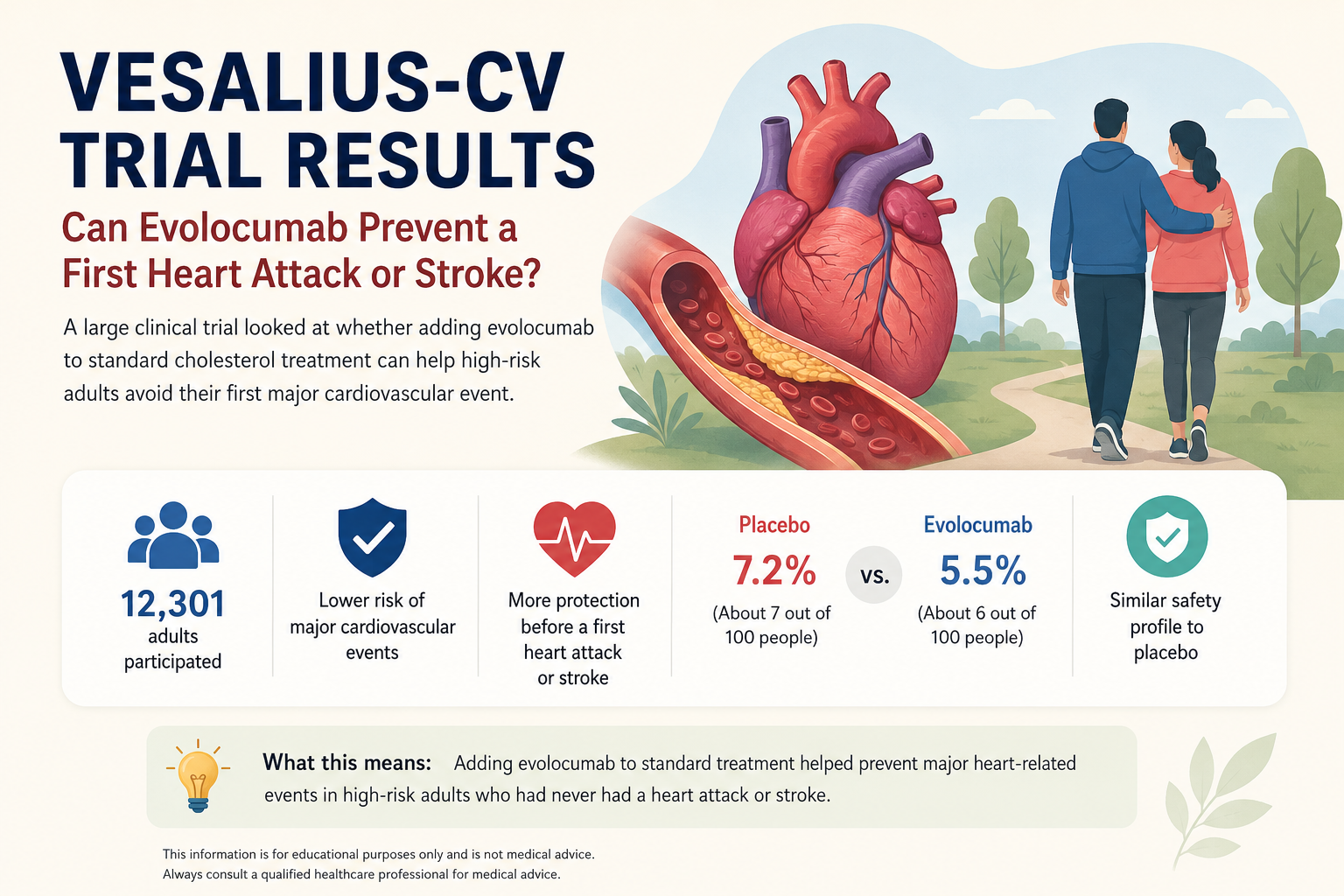
| Participants | 12,301 adults |
| Treatment | Evolocumab + standard cholesterol treatment |
| Comparison | Placebo + standard treatment |
| Follow-up | About 4½ years |
| Goal | Prevent a first major cardiovascular event |
Why Was This Study Done?
Earlier studies showed that evolocumab helped people who had already experienced a heart attack or stroke.
Researchers now wanted to answer a different question:
Can evolocumab help prevent the first major cardiovascular event in people who are already at high risk?
Finding the answer could help doctors decide whether earlier treatment can reduce future heart attacks and strokes.
How Was the Study Conducted?
The study included 12,301 adults who were at high cardiovascular risk but had never experienced a heart attack or stroke.
Everyone continued taking their usual cholesterol-lowering medicines, such as statins.
Participants were randomly assigned to receive either:
- Evolocumab, or
- Placebo, an inactive treatment with no active medicine.
Researchers then followed both groups for about 4½ years and compared how many people experienced major cardiovascular events.
How Does Evolocumab Work?
Your liver naturally removes LDL (“bad”) cholesterol from your blood.
A protein called PCSK9 slows down this process.
Evolocumab blocks PCSK9, allowing the liver to remove more LDL cholesterol.
Lower LDL cholesterol may reduce the build-up of fatty deposits inside arteries, lowering the risk of heart attacks and strokes over time.
What Did the Study Find?
The results were encouraging.
During the study:
- 7.2% of people receiving placebo experienced a major cardiovascular event.
- 5.5% of people receiving evolocumab experienced one.
What does that mean?
Imagine 100 people similar to those in this study.
- Without evolocumab, about 7 people experienced a heart attack, stroke, or died from coronary heart disease.
- With evolocumab, about 6 people experienced one of these events.
In simple terms, about 2 fewer people per 100 treated experienced a major cardiovascular event when evolocumab was added to standard cholesterol-lowering treatment. Researchers also found that evolocumab reduced a broader group of cardiovascular problems, including procedures to restore blood flow to blocked arteries. This suggests the benefits were consistent across several important cardiovascular outcomes.
What Does This Mean?
The VESALIUS-CV study suggests that adding evolocumab to standard cholesterol-lowering treatment may provide additional protection against major cardiovascular events in carefully selected people at high cardiovascular risk.
The next question, however, is just as important:
Was Evolocumab Safe?
A treatment should not only work—it should also be safe.
In the VESALIUS-CV study, serious side effects occurred at similar rates in people who received evolocumab and those who received placebo. This suggests that adding evolocumab did not increase major safety concerns during the study.
The most commonly reported non-serious side effects were:
- Joint pain
- Muscle pain
- Headache
- Rash
Overall, the safety findings were consistent with what researchers already knew about evolocumab from earlier studies.
Who Might Benefit From These Results?
The findings from this study apply to adults who:
- Are at high cardiovascular risk
- Are already receiving standard cholesterol-lowering treatment, such as statins
- Have never experienced a heart attack or stroke
The study does not suggest that everyone with high cholesterol should receive evolocumab. Instead, it provides evidence that some high-risk individuals may benefit from additional cholesterol lowering after assessment by their healthcare provider.
What Are the Strengths and Limitations?
Every clinical trial has strengths and limitations, and understanding both helps put the results into perspective.
Strengths
- Included more than 12,000 participants
- Conducted across multiple countries
- Followed participants for about 4½ years
- Used a rigorous study design that reduces bias and improves confidence in the findings
Limitations
The results apply only to the type of participants included in this study and may not apply to everyone with high cholesterol. Also, the available journal publication describes the study design, while the final study results are currently available on ClinicalTrials.gov. This article therefore relies primarily on the ClinicalTrials.gov results.
Why Does This Study Matter?
Heart disease often develops silently over many years.
The VESALIUS-CV trial suggests that lowering LDL (“bad”) cholesterol even further may help prevent a first heart attack or stroke in some people who remain at high cardiovascular risk despite standard treatment.
Although the overall benefit was modest, preventing even a small number of cardiovascular events can have an important impact when applied to large populations.
Trialora’s Bottom Line
The VESALIUS-CV trial showed that adding evolocumab to standard cholesterol-lowering treatment reduced the risk of major cardiovascular events in adults at high cardiovascular risk who had never experienced a heart attack or stroke.
These findings do not apply to everyone with high cholesterol, but they suggest that evolocumab may be an additional treatment option for carefully selected high-risk patients.
As always, treatment decisions should be made together with a qualified healthcare professional.
Frequently Asked Questions
What is evolocumab?
Evolocumab is a medicine that lowers LDL (“bad”) cholesterol. It belongs to a group of medicines called PCSK9 inhibitors.
Does evolocumab replace statins?
No. In this study, evolocumab was used along with standard cholesterol-lowering treatment, including statins.
How is evolocumab given?
It is given as an injection under the skin, usually every two weeks or once a month.
Where can I read the original study?
The complete study details and results are publicly available on ClinicalTrials.gov (Study ID: NCT03872401).
Key Takeaways
- VESALIUS-CV included 12,301 adults at high cardiovascular risk.
- Adding evolocumab reduced the risk of a first major cardiovascular event compared with placebo.
- About 2 fewer people per 100 treated experienced a major cardiovascular event during the study.
- Serious side effects occurred at similar rates in both treatment groups.
- The findings support evolocumab as an additional treatment option for selected high-risk adults.
Medical Disclaimer
This article is for educational purposes only and is based on publicly available clinical trial data. It is not intended to replace professional medical advice, diagnosis, or treatment. Always consult a qualified healthcare professional before making decisions about your health or medications.
About This Article
This article is based primarily on publicly available information from ClinicalTrials.gov and, where available, peer-reviewed scientific publications.
It has been independently written by Trialora to explain clinical trial results in plain language.
Trialora is not affiliated with the study sponsor, ClinicalTrials.gov, or any regulatory authority.
References
- ClinicalTrials.gov. Effect of Evolocumab in Patients at High Cardiovascular Risk Without Prior Myocardial Infarction or Stroke (VESALIUS-CV). NCT03872401. Study details and posted results.
- Bohula EA, Marston NA, Ruzza A, et al. Rationale and design of the effect of evolocumab in patients at high cardiovascular risk without prior myocardial infarction or stroke (VESALIUS-CV) trial. American Heart Journal. 2024;269:179–190.