Trial Snapshot
| Detail | Information |
| Trial name | ACHiEvE-SCD |
| ClinicalTrials.gov ID | NCT05451940 |
| Condition | Sickle cell disease (SCD) |
| Treatment studied | Erythropoietin (EPO) alongside hydroxyurea |
| Phase | Phase 1/2 |
| Study design | Interventional, single group, no separate control group |
| Actual enrollment | 17 participants |
| Study status | Completed |
| Primary assessment | Hemoglobin response at 12 weeks |
Why Was This Study Conducted?
Sickle cell disease is an inherited blood disorder that changes the shape and behavior of red blood cells. These cells can break down faster than usual, causing chronic anemia—a condition in which the blood has too little hemoglobin or too few healthy red blood cells.
Hemoglobin carries oxygen around the body. Chronic anemia can affect health and daily life, so researchers are studying ways to address it in people with sickle cell disease.
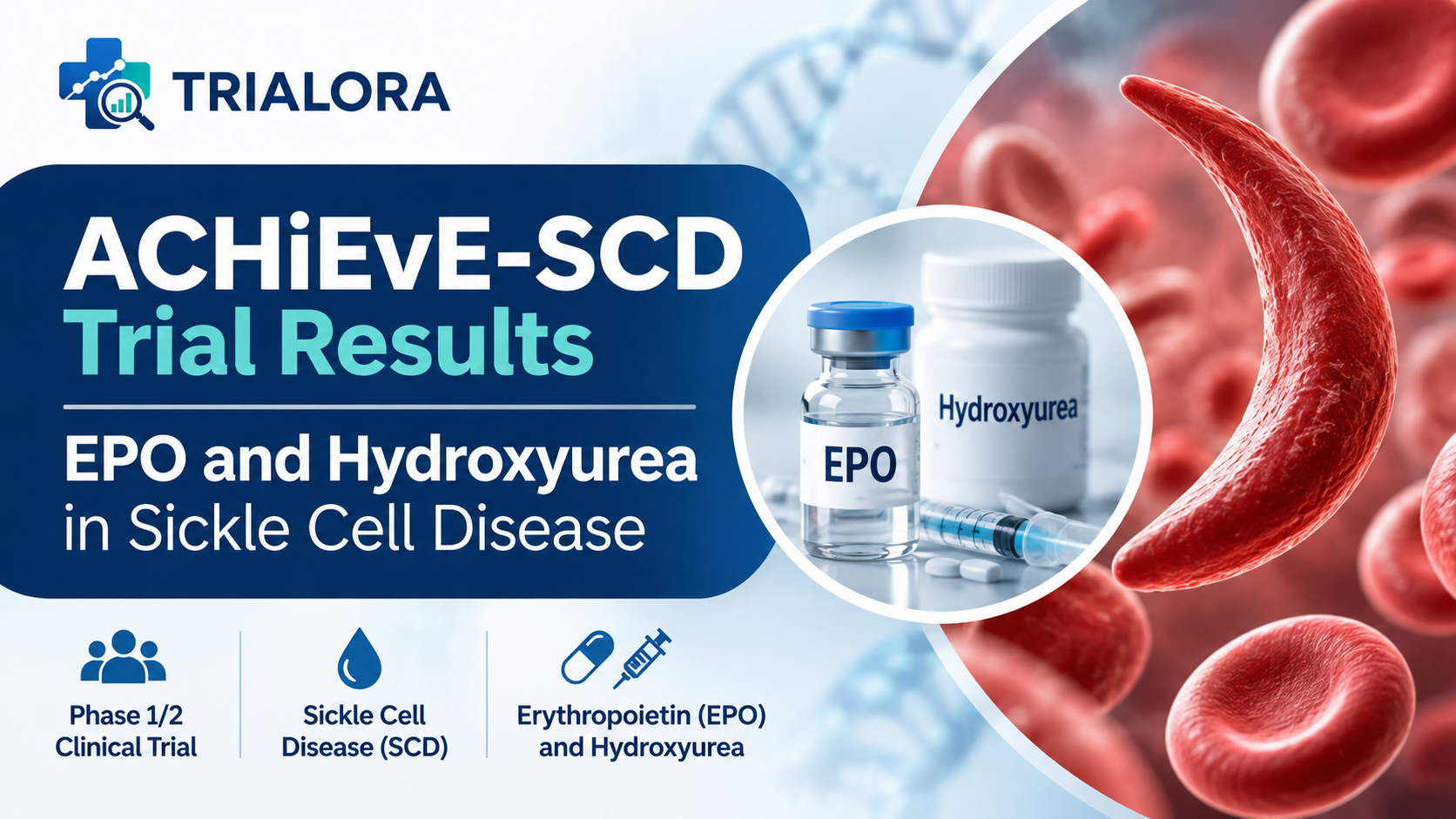
Hydroxyurea is a medicine used to manage sickle cell disease. Erythropoietin, or EPO, is a hormone that signals the body to make red blood cells. The ACHiEvE-SCD trial evaluated EPO alongside stable hydroxyurea treatment to assess safety and changes in anemia.
How Did the Treatment Work?
Participants continued taking hydroxyurea at a stable dose and received increasing doses of EPO by injection under the skin, as tolerated. The study used epoetin alfa or a biosimilar, a medicine designed to be highly similar to an existing biological medicine.
Hydroxyurea can increase fetal hemoglobin, a form of hemoglobin that helps reduce red blood cell sickling. EPO signals the bone marrow—the tissue where blood cells are made—to produce red blood cells.
About the ACHiEvE-SCD Clinical Trial
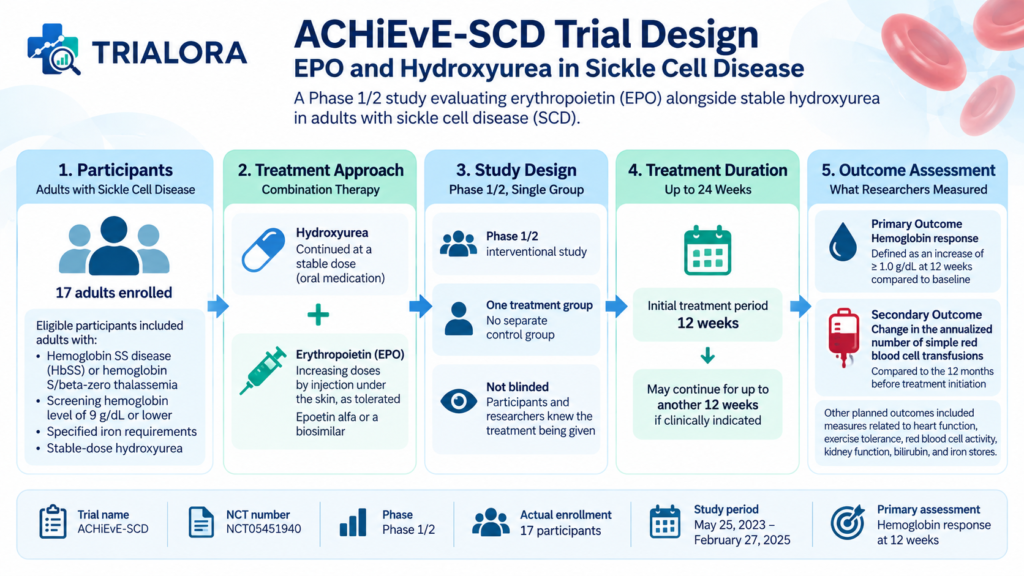
ACHiEvE-SCD was a Phase 1/2 interventional study sponsored by an investigator at the University of Pittsburgh. Phase 1/2 studies can assess treatment safety while also collecting early evidence about how a treatment affects a disease or health measure.
Participants and researchers knew which treatment was being given. The study did not include a separate comparison group.
The initial treatment period lasted 12 weeks. Participants could continue for up to another 12 weeks if clinically indicated. The primary hemoglobin assessment was scheduled at week 12.
The study began on May 25, 2023, reached primary completion on December 13, 2024, and was completed on February 27, 2025.
Who Participated?
The trial enrolled 17 adults. Sixteen completed treatment and were included in the baseline and primary outcome analysis; one participant did not complete treatment following a physician’s decision.
Eligibility included adults with hemoglobin SS disease (HbSS) or hemoglobin S/beta-zero thalassemia, a screening hemoglobin level of 9 g/dL or lower, and specified iron requirements. Participants also needed to be receiving stable-dose hydroxyurea.
The 16 participants included in the primary analysis had the following characteristics:
| Characteristic | Participants |
| Mean age | 30 years |
| Age range | 18–50 years |
| Female | 9 |
| Male | 7 |
| Enrolled in Nigeria | 14 |
| Enrolled in the United States | 2 |
| HbSS disease | 16 |
Although the eligibility criteria permitted more than one sickle cell disease subtype, all participants in the primary analysis had HbSS disease.
What Did Researchers Measure?
The primary outcome was the proportion of participants whose hemoglobin increased by at least 1.0 gram per deciliter (g/dL) after 12 weeks compared with their starting level. This threshold defined a hemoglobin response.
A secondary outcome was the change in the annualized number of simple red blood cell transfusions. “Annualized” means that the observed transfusion rate is expressed as a yearly rate.
Researchers also planned to assess heart function, exercise tolerance, red blood cell production and breakdown, kidney function, bilirubin, and iron stores.
What Were the Results?
Hemoglobin response
Fifteen of the 16 participants included in the primary analysis had a hemoglobin increase of at least 1.0 g/dL at week 12.
The mean hemoglobin change from baseline to week 12 was +3.0 g/dL, with a standard deviation of 1.6 g/dL. Standard deviation describes how much individual results varied around the average.
Red blood cell transfusions
The reported mean change in the annualized number of transfusions was −1.1 transfusions per year, with a standard deviation of 3.7.
The negative value indicates a decrease in the average annualized transfusion rate. Individual changes varied.
Other planned outcomes
Several other planned outcomes did not have results reported, including measures of heart function, exercise tolerance, red blood cell activity, kidney function, bilirubin, and ferritin, a blood marker used to assess iron stores.
The study did not report this information.
Safety and Side Effects
An adverse event is an unwanted medical occurrence during a study; it does not necessarily mean the treatment caused it. A serious adverse event is an event that meets formal seriousness criteria, such as being life-threatening or requiring or prolonging hospitalization.
The reported safety counts covered the period from treatment initiation through the end of the treatment period, up to 12 weeks.
| Safety measure | Participants affected |
| Participants with other reported adverse events | 15 of 17 |
| Participants with serious adverse events | 2 of 17 |
| Deaths | 0 of 17 |
Two serious adverse events were reported:
- Vaso-occlusive crisis: One participant experienced three Grade 3 episodes. Researchers considered them unrelated or unlikely to be related to the study intervention because they were within that participant’s expected baseline number of crises.
- Myelodysplastic syndrome: One participant was diagnosed with this bone marrow disorder during the study. The participant had already been undergoing evaluation for worsening chronic anemia before enrolling, and the event was considered unrelated to the study intervention.
Other reported events included increased cardiac troponin I, reduced neutrophil counts, dizziness, infections, pain, palpitations, and priapism. Some events were assessed as possibly or unlikely related to the study intervention; others were considered unrelated. The decreased neutrophil counts were attributed to hydroxyurea rather than EPO.
The reported events describe the safety findings during the treatment period. They do not establish the combination’s longer-term safety.
Study Strengths and Limitations
The study defined a primary hemoglobin response threshold and reported results for that outcome. It also collected information on transfusion use and safety, with participants enrolled in Nigeria and the United States.
The small participant group limits how broadly the findings can be applied. All participants in the primary analysis had HbSS disease, so the results do not establish outcomes for people with other sickle cell disease subtypes.
The single-group design also means that the observed changes cannot be attributed to EPO with certainty or used to determine whether the combination performed better than hydroxyurea alone.
The study sponsor supplied EPO for the 12-week treatment period but could not provide it for a longer period. Participants who wished to continue during observation needed to pay out of pocket or obtain insurance coverage, and most had to stop EPO after the treatment period. Long-term safety could not be evaluated.
What Do These Results Mean?
The study observed increases in hemoglobin for most participants included in the primary analysis and a decrease in the mean annualized transfusion rate. These findings provide early data on EPO alongside hydroxyurea in adults with sickle cell disease.
The results do not establish whether the combination improves long-term health. The study’s design, small participant group, and limited treatment period restrict the conclusions that can be drawn about its benefits and risks.
What’s Next?
The study did not report this information.
Reference
- ClinicalTrials.gov. ACHiEvE-SCD: Assessing Combination Hydroxyurea and Exogenous Erythropoietin in Sickle Cell Disease. Identifier: NCT05451940. https://clinicaltrials.gov/study/NCT05451940
Medical Disclaimer: The information provided in this article is for educational purposes only and should not be considered medical advice. Always consult a qualified healthcare professional regarding medical decisions.
Trialora Promise: Every Trialora article is based on publicly available scientific evidence, with ClinicalTrials.gov as the primary source of information. Our mission is to explain clinical research in plain language while maintaining scientific accuracy, transparency, and objectivity.
Making Clinical Trials Easy to Understand.