Lupus is an autoimmune disease in which the immune system attacks the body’s own tissues. It can affect the skin and other organs. Researchers are investigating treatments that target specific immune pathways involved in the disease.
Enpatoran is an investigational oral drug designed to inhibit toll-like receptors 7 and 8 (TLR7/8), which are involved in immune signalling. The WILLOW Phase 2 clinical trial evaluated enpatoran in people with systemic lupus erythematosus (SLE) and cutaneous lupus erythematosus (CLE).
How was the WILLOW study designed?
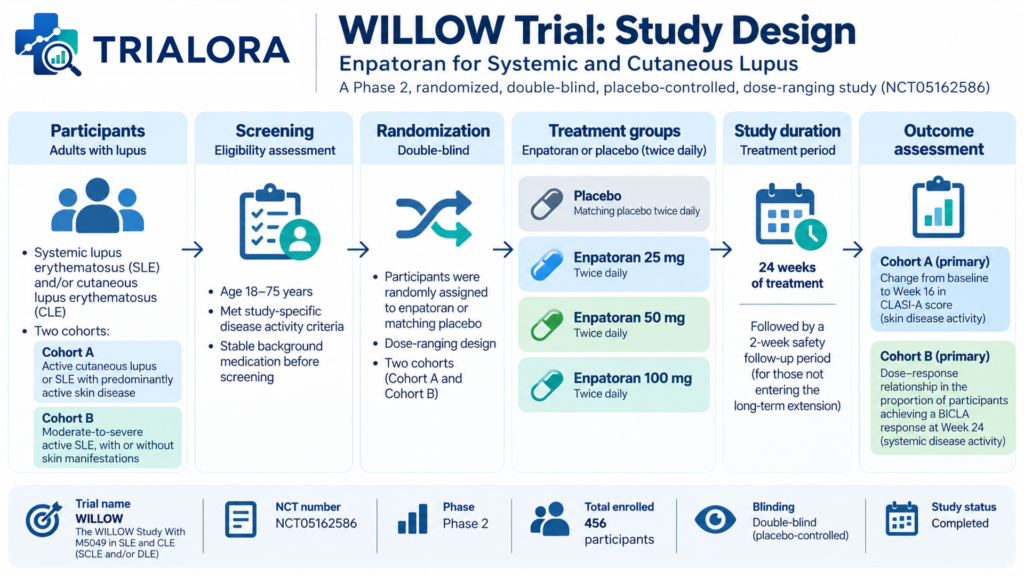
WILLOW (ClinicalTrials.gov identifier: NCT05162586) was a randomized, double-blind, placebo-controlled, dose-ranging Phase 2 study. The study is completed. Participants received enpatoran alongside standard care or a matching placebo for 24 weeks.
The study included two cohorts:
- Cohort A: Participants with active cutaneous lupus or SLE with predominantly active skin disease.
- Cohort B: Participants with moderate-to-severe active SLE, with or without skin manifestations.
Participants assigned to enpatoran received 25 mg, 50 mg, or 100 mg twice daily.
Who participated in the study?
The WILLOW study enrolled 456 participants across two cohorts. Cohort A included 104 participants in the safety population, with 26 in each treatment group.
Cohort B included 354 participants in the safety population and 353 in the efficacy population. Among the Cohort B efficacy population, 335 (95%) were female. The median age was 41 years (interquartile range, 33–51 years), and participants were recruited from 132 centres in 22 countries.
The registry and publication reported different participant counts for Cohort A’s skin-disease efficacy analysis; this discrepancy remains unresolved.
What did researchers measure?
The primary outcome differed between the cohorts.
In Cohort A, researchers measured the change from baseline to Week 16 in the Cutaneous Lupus Erythematosus Disease Area and Severity Index activity score (CLASI-A), which assesses skin disease activity.
In Cohort B, the primary objective was to assess the dose–response relationship in the proportion of participants achieving a BICLA response at Week 24. BICLA stands for British Isles Lupus Assessment Group-based Composite Lupus Assessment, a measure of improvement in systemic lupus disease activity.
Researchers also evaluated other clinical outcomes, biological measures of immune activity, and safety.
What did the WILLOW trial find?
Cohort A: Skin disease outcomes
Mean reductions in CLASI-A score at Week 16 were:
| Treatment group | Mean reduction in CLASI-A score |
| Placebo | 5.0 points |
| Enpatoran 25 mg twice daily | 9.0 points |
| Enpatoran 50 mg twice daily | 10.2 points |
| Enpatoran 100 mg twice daily | 9.7 points |
A dose–response relationship for skin disease activity was reported (p=0.0002).
The registry and publication reported different participant counts for the CLASI-A efficacy analysis. The registry listed 23, 22, 24, and 25 participants in the placebo, 25 mg, 50 mg, and 100 mg groups, respectively. The publication reported 26, 23, 25, and 26 participants in those groups. This discrepancy remains unresolved.
Cohort B: Systemic lupus outcomes
The primary objective was not met: the study did not establish a statistically significant dose–response relationship in BICLA response at Week 24 (p=0.14).
| Treatment group | Participants with a BICLA response | Odds ratio versus placebo (95% CI) |
| Placebo | 37/94 (39%) | Reference |
| Enpatoran 25 mg twice daily | 41/71 (58%) | 2.2 (1.1–4.0) |
| Enpatoran 50 mg twice daily | 36/74 (49%) | 1.5 (0.8–2.8) |
| Enpatoran 100 mg twice daily | 56/114 (49%) | 1.6 (0.9–2.8) |
Among participants taking at least 10 mg/day of prednisone-equivalent corticosteroids at baseline, researchers also assessed BICLA response combined with a clinically meaningful corticosteroid reduction. The reported rates were 31% with placebo, 59% with enpatoran 25 mg, 56% with 50 mg, and 48% with 100 mg.
The study also reported reductions in interferon-alpha activity and interferon gene-signature activity. These biological changes indicate effects on immune-system activity but do not, on their own, establish lasting clinical improvement.
What safety findings were reported?
In Cohort B, treatment-emergent adverse events (TEAEs)—medical events that occurred after treatment began—were reported at similar overall rates across the treatment groups.
| Safety outcome | Placebo (n=95) | Enpatoran 25 mg (n=71) | Enpatoran 50 mg (n=74) | Enpatoran 100 mg (n=114) |
| Any TEAE | 61 (64%) | 43 (61%) | 47 (64%) | 70 (61%) |
| Serious adverse events | 3 (3%) | 1 (1%) | 3 (4%) | 5 (4%) |
| Adverse event leading to study-drug discontinuation | 6% | 3% | 7% | 3% |
| Deaths | 0 | 0 | 0 | 0 |
| Diarrhoea | 7 (7%) | 4 (6%) | 2 (3%) | 2 (2%) |
The most commonly reported TEAE in Cohort A was upper respiratory tract infection. Serious adverse events occurred in 1 of 26 participants (4%) receiving placebo, 1 of 26 (4%) receiving enpatoran 25 mg, none receiving 50 mg, and 2 of 26 (8%) receiving 100 mg.
These data do not establish long-term safety.
What are the study’s limitations?
- Follow-up: The available treatment-period findings cannot establish whether clinical effects persist over the longer term.
- Secondary and exploratory findings: These provide additional information but do not replace the primary outcome.
What do the findings mean?
The WILLOW results provide information about enpatoran’s effects on skin and systemic lupus outcomes and on biological measures of immune activity. They do not establish long-term benefit or prove that enpatoran is an effective lupus treatment.
A separate long-term extension study was ongoing at the time of the Cohort B publication. Further follow-up would be needed to understand outcomes beyond the main study period.
References
- ClinicalTrials.gov. The WILLOW Study With M5049 in SLE and CLE (SCLE and/or DLE). NCT05162586. https://clinicaltrials.gov/study/NCT05162586
- Morand EF, et al. Enpatoran, a Toll-like receptor 7/8 inhibitor, in moderate-to-severe systemic lupus erythematosus: findings from Cohort B of a multicentre, international, double-blind, placebo-controlled dose-finding phase 2 trial. The Lancet. 2026;407:1809–1824. https://doi.org/10.1016/S0140-6736(26)00463-0
- Morand EF, et al. Efficacy and safety of enpatoran, a Toll-like receptor 7/8 inhibitor, in patients with skin manifestations of cutaneous lupus erythematosus or systemic lupus erythematosus: findings from Cohort A of a multicentre, international, double-blind, placebo-controlled, dose-finding phase 2 trial. The Lancet Rheumatology. 2026;8(7)–e527. https://doi.org/10.1016/S2665-9913(25)00337-6
About This Article
This article explains the design, results, and findings of the WILLOW clinical trial. It is based primarily on publicly available clinical trial information and supporting scientific publications.
Trialora independently prepares this content to help readers understand clinical trial information in clear and plain language. Trialora is not affiliated with, funded by, sponsored by, or endorsed by the study sponsor, investigators, ClinicalTrials.gov, or any regulatory authority, unless explicitly stated otherwise.
The information in this article reflects the study details and results available from the sources reviewed at the time of publication. Findings from one clinical trial should not automatically be considered applicable to every patient or population.
Trialora Promise
Every Trialora article is based primarily on publicly available evidence from ClinicalTrials.gov and other trusted scientific sources. Our mission is to explain complex clinical research in plain language while maintaining scientific accuracy, transparency, and objectivity.
Making Clinical Trials Easy to Understand.
Evidence-Based | Plain Language | Trusted Information
Medical Disclaimer
This content is intended for educational purposes only and should not be considered medical advice. Always consult a qualified healthcare professional regarding medical decisions.